

Freebie of the week: CicLAvia open streets for biking and more
- October 9, 2026
What if you had more than six miles of open, car-free streets to cruise on your skates, bike or feet, all across downtown Los Angeles? Well, on Sunday, Oct. 11, you will.
The fall 2026 CicLAvia promises to be the biggest ever stretching all across the area, from 9 a.m. to 4 p.m. It’s not a race, just a fun day out. Enter anywhere along the route.
Organizers plan to set up four hubs in Echo Park, Chinatown, Little Tokyo and Mariachi Plaza in Boyle Heights, with restrooms, water refilling stations, basic bike repair, bike parking and seating. There will even be pedicabs available for those who need them. You can see the route map here: ciclavia.org/events/heart-of-la-2026-10/
Kids are welcome, but this isn’t a good place to teach because of crowds. Check the website for tips about bringing kids. Bring a refillable water bottle and wear a helmet.
Only people-powered vehicles are allowed on the streets during this event, although there are certain places where cars can cross. Learn more: ciclavia.org
Orange County Register
Read More
A magnitude 7.7 earthquake shakes Panama, prompting evacuations
- October 9, 2026
By JUAN ZAMORANO, MEGAN JANETSKY and ALMA SOLÍS
PANAMA CITY (AP) — A powerful magnitude 7.7 earthquake struck Panama on Friday morning, shaking buildings in the capital and prompting evacuations.
The quake, which was felt as far away as neighboring Colombia, was centered about 10 kilometers (6 miles) southwest of the remote community of Pitaloza Arriba, in the central province of Herrera, the U.S. Geological Survey said. It struck at a depth of 10 kilometers (6 miles). USGS initially reported the quake as magnitude 8, then revised it to 7.6 and later to 7.7.
Visibly shaken residents of Panama City gathered outside as they waited for news of the quake’s impact on Friday. Multiple aftershocks followed, including a magnitude 5.8 and a magnitude 5.5.
“We felt it very strongly. It knocked things over in the kitchen, but we’re okay, though we’re very scared,” Rosendo Domínguez, 60, who is from Herrera province, where the earthquake struck, told The Associated Press by phone. “Everyone is outside, scared.”
Omar Smith of the National Civil Protection Service said on the Telemetro Reporta news channel that damage was concentrated in the central provinces of Veraguas, Herrera and Los Santos. He said there were no reports of damage in the capital, which is known for its hundreds of skyscrapers.
Smith said several injuries have been reported, including one person struck by debris from a partially collapsed structure in the city of Penonomé. He confirmed a partial collapse and cracks at the cathedral in the district’s main square, as well as damage in the governor’s office building and the Dos Continentes hotel. No casualties were immediately reported.
Panamanian President José Raúl Mulino called for calm on Friday, writing on X: “What happened should not be used to cause alarm or disorder.”

The Panama Canal Authority said operations were continuing normally along the key global trade route. It said its priority was the safety of employees, vessels and crews and that specialized technical teams were inspecting facilities for possible damage.
Panama lies along the “Ring of Fire,” a 40,000-kilometer (25,000-mile) arc of volcanoes and fault lines around the Pacific Basin, where most of the world’s earthquakes occur.
The National Weather Service issued a tsunami warning Friday for the coasts of Panama, Colombia, Ecuador, Nicaragua and Guatemala. It warned that waves ranging from 3 to 9 feet (1 to 3 meters) above tide may occur in some coastal areas of Panama.
Alerts were also issued in El Salvador and as far as Chile’s Easter Island, about 3,500 kilometers (2,175 miles) off Chile’s mainland coast. Chile’s government placed the island under a precautionary advisory.
Nearby countries sent messages of support Friday afternoon. Colombian President Abelardo de la Espriella, whose country was recently hit by earthquakes, expressed his solidarity with the Panamanian people and their government during what he called “difficult times.”
“Panama is not alone! You can count on Colombia’s support and our full willingness to provide whatever assistance is needed,” he wrote on X.
The U.S. Embassy in Panama said it was “closely monitoring” the aftermath of the quake and accounting for the welfare of its citizens in Panama, a well-known retirement destination for Americans.
Janetsky reported from Mexico City, and Solís reported from Panama City. Gabriela Molina in Quito, Ecuador, Clara Preve in Buenos Aires, Argentina, Eléonore Hughes in Rio de Janeiro, María Verza in Mexico City and Becky Bohrer in Juneau, Alaska, contributed.
Follow AP’s coverage of Latin America and the Caribbean at https://apnews.com/hub/latin-america
 Orange County Register
Legal path seems narrow to challenge livestream of Fort Hood shooter’s execution, experts say
- October 9, 2026
By ED WHITE and CLAUDIA LAUER
Any effort to challenge the Trump administration’s plan to livestream the firing-squad execution of Fort Hood shooter Nidal Malik Hasan might rest solely with the man sentenced to death for killing 13 people at the Texas military base in 2009, experts say.
Broadcasting the event worldwide isn’t mentioned in the Army rules governing how rare military executions are carried out. But that doesn’t mean there is a viable legal path to oppose it by anyone besides Hasan. And he hasn’t signaled whether he will even try to stop anything related to his Dec. 3 death sentence.
Officials at the Pentagon said Thursday that Hasan’s execution by a firing squad would be livestreamed and that more details would follow. A day earlier, Defense Secretary Pete Hegseth said, “We’ll make sure that people are able to watch it, that it’s public.”
“Other than Hasan, I’m not sure anyone could” have legal standing to stop a livestream, said Brenner Fissell, a professor at Villanova University’s law school and an expert in military justice.
Could US parents try to halt livestream?
Fissell, however, tossed up a novel possibility: parents who don’t want their children to see a person blasted with bullets on the internet, either in real time or viewed later. Army regulations say, “No person under the age of 18 shall witness” a military execution.
“That’s explicit,” Fissell said. “It’s a question of whether a livestream counts as a presence. … I think it violates the spirit of the regulation.”
The regulations, he added, weren’t written to contemplate witnesses outside the actual site of an execution — and certainly not a livestream.
“This actually has not been explored enough,” Fissell said.
Eugene R. Fidell, a visiting lecturer at Yale Law School specializing in military law, said he doesn’t see a lot of legal options to challenge most of the unfolding details of Hasan’s execution, though he agrees that Hasan would have standing to object with a petition, known as habeas corpus, in U.S. District Court.
“Arguing the Army can’t livestream it because some parent wouldn’t be able to stop their kid from watching it on the computer strikes me as a very unlikely piece of litigation,” Fidell said. “Better legal minds than me maybe can come up with a way to make that argument, but I don’t see it.”
Last firing squad was in WWII
Hasan, an Army psychiatrist who held the rank of major, walked into a medical building on Nov. 5, 2009, where soldiers at Fort Hood were waiting to receive medical clearance for deployment. He shouted “Allahu akbar” — Arabic for “God is great!” — and opened fire and also shot at the backs of soldiers fleeing toward the parking lot.
Hasan said it was an effort to stop them from going to Afghanistan and killing his fellow Muslims. He is paralyzed from the waist down after being shot in the back by law enforcement, and he now uses a wheelchair.
Clergy, including U.S. Catholic bishops, and some officials criticized the livestreaming announcement. Vice President JD Vance, meanwhile, told reporters that he wouldn’t watch it and expressed some doubt whether a livestream would happen.
President Donald Trump signed off on Hasan’s execution, which would be the first by a firing squad since World War II. The last military execution happened on April 13, 1961, when Army Pvt. John Bennett was killed by hanging.
A 2023 update to the Army regulation on executions gave the Secretary of the Army discretion on choosing a method, in part to ease hurdles to conducting executions at Guantanamo Bay, Fidell said.
A firing squad is “clearly a legal method of execution in the military,” Fissell said.
Orange County Register
Read More
Coastal flood warning active for Orange County Coast and San Diego County Coastal Areas until Sunday afternoon
- October 9, 2026
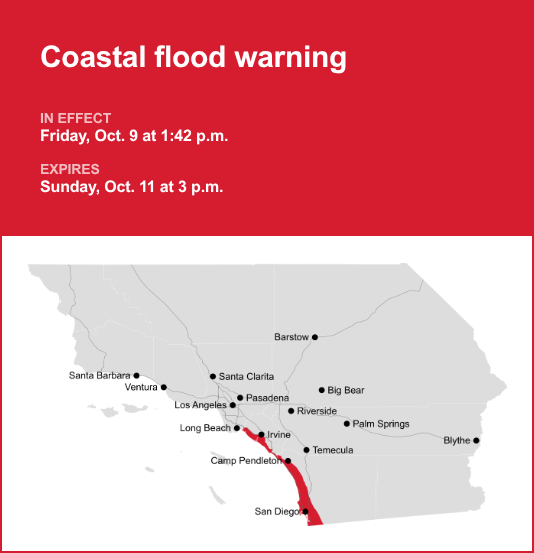
Orange County Coast and San Diego County Coastal Areas are the focus of a coastal flood warning released at 1:42 p.m. on Friday by the National Weather Service. The warning is in effect until Sunday Oct. 11, at 3 p.m.
“Significant coastal flooding and erosion possible,” according to the NWS San Diego CA. “Greatest impacts on Sunday morning from Tropical Storm Rachel in combination of increased swell, onshore winds, and high tides locally over 7 feet.”
“Numerous roads and walking paths may be closed due to high water. Low-lying property including homes, businesses, and some critical infrastructure may flood. Shoreline erosion will occur during high tides in the mornings. Increased surf will lead to a high risk of rip currents,” the NWS said. “Take the necessary actions to protect flood-prone property. If travel is required, do not drive around barricades or through water of unknown depth. Remain out of the water to avoid hazardous swimming conditions.”
Road closures
Updates on road closures can be found on CalTrans’ website or mobile app or by calling 800-427-7623.
Emergency alerts in Southern California
For “considerable or catastrophic” hazards, emergency alerts will be sent to all enabled mobile phones in the area. To monitor lesser risk, residents are advised to sign up for county alert systems and to monitor agencies’ social media. How to sign up for alerts in your area:
Where to get sandbags
If you’re in an area at risk of flooding, sandbags can be one line of defense. County fire departments typically offer a limited supply of free sandbags for residents of their nearby communities. You should bring your own shovel to fill your bags, and be prepared to show proof of residency.
Sand and sandbags can also be purchased at many home improvement and hardware stores.
Here are links of locations that might have sandbags in your area:
Los Angeles County https://dpw. Lacounty. Gov/dsg/sandbags/
Orange County https://ocfa. Org/AboutUs/Departments/OperationsDirectory/Sandbags. Aspx
San Bernardino County https://sbcfire. Org/sandbags/
Riverside County https://rvcfire. Org/resources/fire-stations
How to fill a sandbag
Not sure how to fill your sandbags? Watch the how-to video, provided by the City of Seal Beach.
Your guide to weather alerts: advisories, watches, and warnings
Flash flood warning: Take action.
A flash flood warning is issued when a flash flood is imminent or occurring. If you are in a flood-prone area, move immediately to high ground. A flash flood is a sudden violent flood that can take from minutes to hours to develop. It is even possible to experience a flash flood in areas not immediately receiving rain.
Flood warning: Take action.
A flood warning is declared when flooding is on the verge of happening or is already underway.
Flood advisory: Be aware.
A flood advisory is issued when flooding is not expected to be bad enough to issue a warning. However, it may cause significant inconvenience, and if caution is not exercised, it could lead to situations that may threaten life and/or property.
Flood watch: Be prepared.
A flood watch is issued when conditions are favorable for flooding. It does not mean flooding will occur, but it is possible.
Weathering the storm: Flood safety guidelines from the NWS
Floods can pose a significant threat, especially if you live in a flood-prone area or find yourself camping in a low-lying region. To ensure your safety, the NWS offers essential flood safety guidelines:
Move to higher ground:
If you’re in a flood-prone area, or if you’re camping in a low-lying spot, move to higher ground as a first step.
Adhere to evacuation orders:
When local authorities issue an evacuation order, promptly comply. Before leaving, secure your home by locking it.
Disconnect utilities and appliances:
If time permits, disconnect your utilities and appliances. This precaution minimizes electrical hazards during flooding.
Avoid basements and submerged areas:
Avoid basements or rooms submerged in water with electrical outlets or cords. Preventing electrical accidents is crucial.
Evacuate promptly for safety:
If you notice sparks or hear buzzing, crackling, snapping, or popping sounds, evacuate without delay. Do not enter water that may carry an electrical charge.
Stay away from floodwaters:
Never attempt to walk through floodwaters, even if they appear shallow. Just 6 inches of fast-moving water can forcefully sweep you off your feet.
Seek higher ground when trapped:
Should you become trapped by moving water, reach the highest point possible and dial 911 to contact emergency services.
During heavy rain, flooding is possible, especially in low-lying and flood-prone areas. Never drive through water on the road, even if it does not appear to be deep. It takes just 12 inches of rushing water to carry away most cars, according to the NWS. Prioritize your safety by staying informed and prepared.
For more local weather alerts, visit our Weather Advisory page
Orange County Register
Kings seek good fortune and 1st victory in Las Vegas
- October 9, 2026
The Kings remain in search of their first victory of the new season and to pursue it they’ll go to a place where many have won big but many more have lost it all: the Vegas Strip.
They’ll confront a Golden Knights franchise that has captured five Pacific Division crowns, three Clarence S. Campbell bowls as Western Conference champs and a Stanley Cup in just nine seasons of existence. After reaching the Stanley Cup Final last season, they started this campaign 4-1-0.
The Kings (0-2-1), meanwhile, possess a solitary point in the standings, positioned above only the rebuilding Calgary Flames. Only those same Flames have given up more goals on average than the Kings’ five per contest and only the Vancouver Canucks have killed penalties at a lesser clip.
On the other side of the special-teams coin, the Kings’ power play has sandwiched a 2-for-3 performance between a pair of blank spots. They went 0 for 4 in their season opener and 0 for 5 in a 2-1 loss to the Florida Panthers in their home opener.
One key piece of their first unit, free-agent addition Mats Zuccarello, won’t be in Vegas, per multiple reports from practice.
Over the past five years, all of which were playoff seasons for the Kings, no player topped 100 cumulative power-play points in black and silver. Their most productive man-advantage weapons across that span, Anže Kopitar and Kevin Fiala, are retired and injured, respectively. After Adrian Kempe’s aggregate 93 points a man up, Drew Doughty’s 67 are the next highest total.
Zuccarello, who played for the Minnesota Wild during that time and signed a one-year deal with the Kings in July, racked up 127, despite missing 65 total games due to injury. He was limited for most of training camp due to a shoulder problem.
With the trip consisting of a quick one-game excursion, the Kings recalled former University of Denver forward Jared Wright from the minors.
Wright has three points in the AHL in two games this season, an assist and two goals, including an overtime game-winner. He had four points in 23 appearances with the Kings last season amid a slew of injuries and departures via trade up front.
For Vegas, Jack Eichel entered Friday’s slate of games tied with Edmonton’ Connor McDavid for the league lead in scoring with 12 points. Captain Mark Stone has five points in as many appearances after signing a two-year contract extension this fall. Defenseman Rasmus Andersson, who vetoed a trade to the Kings before last season, landed in Vegas and also extended. His campaign to date has been rocky though, posting just one point and a -6 rating.
Kings (0-2-1, 1 point) at Vegas (4-1-0, 8 points)
When: 7 p.m. Saturday
Where: T-Mobile Arena, Las Vegas
How to watch: ABTV
Orange County Register
Read More
High school football: Your guide to Friday night’s top games in SoCal
- October 9, 2026
This could be one of those special Friday nights in the high school football season — excellent weather, great games, exciting matchups.
The Southern California News Group will have reporters covering more than 30 games tonight, ready to report on everything that happens.
Before the games start, check out what high school football analyst Michael Huntley has put together — his list of the “players to watch” and his predictions for some of the top games on the Week 7 schedule.
PREDICTIONS: HUNTLEY’S SIX PICKS

Huntington Beach vs. Dana Hills: Dana Hills is 6-0 but its opponents have a record of 9-28 on the field this season. Dana Hills’ Carter Anderson throws for 212 yards per game and Jack Norman has eight touchdown catches. Ohio State commit Brady Edmunds throws for 225 yards per game. This might be the Delta League championship game.
The pick: Dana Hills
Inglewood vs. Palos Verdes: Inglewood ran for 361 yards last week against Mira Costa and had a lot of big plays. Palos Verdes linebacker Weston Reis is a high-level run stopper and the Sea Kings have allowed just 10 points in their last three games.
The pick: Palos Verdes
Norco vs. Chaparral: Chaparral is back to potentially being a top 15 team in the Section with the return of quarterback Dane Weber. Norco throws the ball well too with quarterback Julian Medina and BYU commit Blake Wong returned from injury at receiver last week.
The pick: Chaparral
Millikan vs. Lakewood: Millikan has played a very strong schedule and was competitive against Palos Verdes for a bit until things spiraled last week. Jonah Tuaniga should have a big game at quarterback for the Rams against a Lakewood team that gave up a lot of passing yards against Long Beach Poly last week.
The pick: Millikan

Chaminade vs. Bishop Amat: Chaminade played well against Notre Dame last week and nearly won while playing a freshman quarterback in his first start. Bishop Amat edged Serra despite having three turnovers. Freshman Ayden Bias ran for 110 yards including a 46-yard touchdown run.
The pick: Bishop Amat
Villa Park vs. La Habra: Villa Park struggled offensively against an excellent Corona del Mar team last week after averaging 50 points per game in nonleague play. The Spartans have an excellent linebacker trio in Maverick Declark, Parker Johns and Ethan Hedrick. La Habra ran the ball well in a loss to Capo Valley last week but threw for just 104 yards.
The pick: Villa Park
HUNTLEY’S PLAYERS TO WATCH
Nasir Walker, DE, Crean Lutheran: Walker had 12 tackles with a sack and five hurries in Crean Lutheran’s win over Tustin last week. Crean Lutheran will need to get pressure on Capo Valley quarterback Talon Spencer to stop the Cougars’ high-powered offense.
Logan Zack, LB, Trabuco Hills: Zack has 76 tackles which is the third most in Orange County. Trabuco Hills faces Foothill, which runs the ball on 56 percent of its snaps.

Dane Weber, QB, Chaparral: Weber returned from a thumb injury last week and had four touchdowns in a blowout win over Murrieta Valley. The Cal commit threw for 339 yards with four touchdowns and ran for two scores against this week’s opponent, Norco, last season.
Aaron Patton, DB, Temecula Valley: Patton leads Temecula Valley in interceptions and has 30 tackles. Temecula Valley plays King, which threw four touchdown passes in a win over Corona last week.
Damani Porras, WR/DB, Downey: Porras led Downey in receiving and had an interception against crosstown rival Warren last season. The New Mexico commit has seven receiving touchdowns and an interception this season for the Vikings.

Ethan Coach, LB, St. John Bosco: Coach had nine tackles with two for a loss in the regular season against Orange Lutheran last year. The Washington commit had five tackles with a forced fumble against JSerra last week.
Brandon Billups, DB, Bishop Amat: Billups led Bishop Amat with 11 tackles in its win over Serra last week. He plays a Chaminade team this week that may be playing a freshman quarterback and he had an interception against the Eagles last season.
Joshua Williams, DE, Palos Verdes: Williams leads Palos Verdes in sacks and faces Inglewood, who throws for 238 yards per game. He will need to pressure Inglewood quarterback Lincoln Jahn to slow down the Sentinel’s passing attack.
Ace Taylor, OL, Serra: Taylor is the starting right tackle for Serra and will need to have a big game against Sierra Canyon’s elite defensive line.
Darrien Johnson, WR, Newbury Park: Johnson had 117 yards with two touchdowns last week in a win over Bishop Diego and leads Newbury Park in receiving. The Panthers will need to have a big game throwing the ball to keep pace with Pacifica’s offense.
Caesar Reyes, RB, Garfield: Reyes ran for 374 yards with five touchdowns for Garfield last week against Bell. Garfield is playing South East and ran for 386 yards with six touchdowns against the Jaguars last season.
Orange County Register
No. 21 UCLA football at No. 13 Oregon: Who has the edge?
- October 9, 2026
No. 21 UCLA (4-0, 2-0 Big Ten) at No. 13 Oregon (3-1, 1-0)
When: 12:30 p.m. Saturday
Where: Autzen Stadium, Eugene, Oregon
TV/Radio: CBS (Ch. 2)/790 AM KABC
Line: Oregon by 11.5 points
Injury Report
UCLA: OUT: WR Mikey Matthews (undisclosed), WR Jonah Smith (undisclosed), OL Sam Yoon (undisclosed); DOUBTFUL: DL Ashton Sanders (undisclosed); PROBABLE: DB Tao Johnson (undisclosed)
Oregon: OUT: QB Dante Moore (head), WR Jeremiah McClellan (undisclosed), RB Simeon Price (undisclosed), LB Brayden Platt (undisclosed), OL Trent Ferguson (undisclosed), WR Jack Ressler (undisclosed); DOUBTFUL: DB Aaron Scott Jr. (undisclosed), DB Aaron Flowers (undisclosed).
What’s at stake? Oregon and UCLA have a path to the College Football Playoff. After an early-season loss to No. 18 Oklahoma State, the Ducks can’t afford another defeat with No. 5 Ohio State looming on their schedule. The Bruins can prove they belong in the CFP conversation, and would carry a record that gives them a chance to make the playoff. For Bruins coach Bob Chesney, his staff and the 11 players that were at James Madison, this would their getback for a 51-34 loss in the first round of the 2025 CFP. The Bruins haven’t defeated the Ducks since 2017 and haven’t done so in Eugene since 2004.
Who’s better? Chesney said he learned Oregon has “no weakness” from that CFP opening-round defeat. But he also believes these Bruins are better than those Dukes. Linebacker Samuel Omosigho and the defensive back duo of Rod Pleasant and Scooter Jackson bring speed JMU didn’t have to match Oregon last year. Safety Tao Johnson looks to be back in the fold for UCLA as the defense is coming off its best performance – five turnovers with two pick-sixes in a 54-3 rout of Maryland – of the season. UCLA is averaging 281.5 rushing yards per game (fourth in the FBS). The Bruins will try to remain efficient against Oregon’s four studs across the defensive line. The Ducks also have a capable backup quarterback in Dylan Raiola, who might throw a prettier football than injured starter Dante Moore. Oregon still has the better athletes and speed, but UCLA has minimized the talent gap present last December, and are riding momentum.
Prediction: Oregon 38, UCLA 31. The Bruins cover, but the Ducks are a step too far despite UCLA’s exciting start to the season. Raiola can carve apart the Bruins’ defense, and UCLA’s run game might have its worst day against Oregon’s defensive line, forcing quarterback Nico Iamaleava to beat the Ducks. He’s playing well, but not capable of that feat. Still, hanging with UCLA is a moral victory, although Chesney’s probably allergic to that cliche.
Orange County Register
Read More
Dan Albano’s under-the-radar storylines for Friday’s football games
- October 9, 2026
Support our high school sports coverage by becoming a digital subscriber. Subscribe now
Three under-the-radar storylines to watch in football Friday:
1. How does Mater Dei’s offense perform against JSerra after struggling the past three games?
It feels like Mater Dei (4-2, 0-1) faces a crossroads moment at JSerra (4-2, 0-1) in the second round of the Trinity League.
The Monarchs have averaged 8.3 points in their past three games. Yes, they’ve been against Centennial, Bishop Gorman of Las Vegas and Santa Margarita but the offensive output is trending downward.
JSerra, meanwhile, allowed 34 points in the first half in a 40-14 loss at St. John Bosco last week.
After Mater Dei fell to Santa Margarita 14-7 in last Friday, Monarchs coach Raul Lara took the blame for the offensive struggles.
“For whatever reason, we can’t get the ball in the end zone,” he said. “I might be doing something wrong or something but I got to figure that out.”
Will Mater Dei make changes tonight?
JSerra doesn’t feel like an easy spot to get too tricky. The Lions outscored St. John Bosco 14-6 in the second half to gain momentum for Mater Dei.
JSerra also seems to have a new energy under first-year coach Hardy Nickerson.
2. Can Orange Lutheran stun St. John Bosco again?
Don’t overlook the Lancers (4-2, 1-0) as they return to St. John Bosco (5-1, 1-0) for the first time since upsetting the Braves in the first round of the CIF-SS Division 1 playoffs last season.
The Lancers have again played a challenging schedule to prepare for the Braves. And they’re coming off an impressive 56-21 victory against Servite last week.
Orange Lutheran’s offense looks dangerous but how will its defense handle St. John Bosco running back Maliq Allen? The senior has rushed for 718 yards and 10 TDs.
The Lancers’ performance will reveal a lot about their chances against the rest of the Trinity League. They’re lurking as a potential spoiler.
Next week on Friday, Oct. 16, Orange Lutheran plays host to JSerra at Orange Coast College.
3. Who bounces back in the Villa Park-La Habra game in the Bravo League?
La Habra (5-1, 0-1) plays host to Villa Park (5-1, 0-1) in a clash of teams looking to rebound from their first loss.
The Highlanders fell to Capistrano Valley 42-20 last week. The Spartans lost to Corona del Mar 24-10.
The Bravo League might be Orange County’s best public school league, so avoiding an 0-2 start would be a major boost for La Habra or Villa Park.
La Habra will certainly look to tighten its defense. Look for Villa Park to try to shift its offense back into high gear.
Orange County Register
Read MoreNews
- ASK IRA: Have Heat, Pat Riley been caught adrift amid NBA free agency?
- Dodgers rally against Cubs again to make a winner of Clayton Kershaw
- Clippers impress in Summer League-opening victory
- Anthony Rizzo back in lineup after four-game absence
- New acquisition Claire Emslie scores winning goal for Angel City over San Diego Wave FC
- Hermosa Beach Open: Chase Budinger settling into rhythm with Olympics in mind
- Yankees lose 10th-inning head-slapper to Red Sox, 6-5
- Dodgers remain committed to Dustin May returning as starter
- Mets win with circus walk-off in 10th inning on Keith Hernandez Day
- Mission Viejo football storms to title in the Battle at the Beach passing tournament