

Coastal flood warning active for Orange County Coast and San Diego County Coastal Areas until Sunday afternoon
- October 9, 2026
Orange County Coast and San Diego County Coastal Areas are the focus of a coastal flood warning released at 1:42 p.m. on Friday by the National Weather Service. The warning is in effect until Sunday Oct. 11, at 3 p.m.
“Significant coastal flooding and erosion possible,” according to the NWS San Diego CA. “Greatest impacts on Sunday morning from Tropical Storm Rachel in combination of increased swell, onshore winds, and high tides locally over 7 feet.”
“Numerous roads and walking paths may be closed due to high water. Low-lying property including homes, businesses, and some critical infrastructure may flood. Shoreline erosion will occur during high tides in the mornings. Increased surf will lead to a high risk of rip currents,” the NWS said. “Take the necessary actions to protect flood-prone property. If travel is required, do not drive around barricades or through water of unknown depth. Remain out of the water to avoid hazardous swimming conditions.”
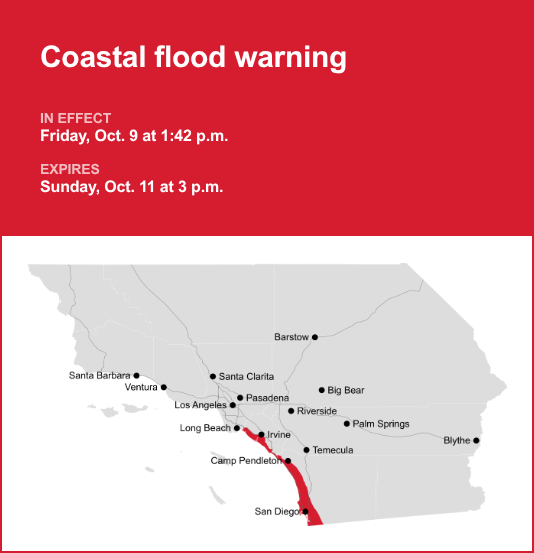
Road closures
Updates on road closures can be found on CalTrans’ website or mobile app or by calling 800-427-7623.
Emergency alerts in Southern California
For “considerable or catastrophic” hazards, emergency alerts will be sent to all enabled mobile phones in the area. To monitor lesser risk, residents are advised to sign up for county alert systems and to monitor agencies’ social media. How to sign up for alerts in your area:
Where to get sandbags
If you’re in an area at risk of flooding, sandbags can be one line of defense. County fire departments typically offer a limited supply of free sandbags for residents of their nearby communities. You should bring your own shovel to fill your bags, and be prepared to show proof of residency.
Sand and sandbags can also be purchased at many home improvement and hardware stores.
Here are links of locations that might have sandbags in your area:
Los Angeles County https://dpw. Lacounty. Gov/dsg/sandbags/
Orange County https://ocfa. Org/AboutUs/Departments/OperationsDirectory/Sandbags. Aspx
San Bernardino County https://sbcfire. Org/sandbags/
Riverside County https://rvcfire. Org/resources/fire-stations
How to fill a sandbag
Not sure how to fill your sandbags? Watch the how-to video, provided by the City of Seal Beach.
Your guide to weather alerts: advisories, watches, and warnings
Flash flood warning: Take action.
A flash flood warning is issued when a flash flood is imminent or occurring. If you are in a flood-prone area, move immediately to high ground. A flash flood is a sudden violent flood that can take from minutes to hours to develop. It is even possible to experience a flash flood in areas not immediately receiving rain.
Flood warning: Take action.
A flood warning is declared when flooding is on the verge of happening or is already underway.
Flood advisory: Be aware.
A flood advisory is issued when flooding is not expected to be bad enough to issue a warning. However, it may cause significant inconvenience, and if caution is not exercised, it could lead to situations that may threaten life and/or property.
Flood watch: Be prepared.
A flood watch is issued when conditions are favorable for flooding. It does not mean flooding will occur, but it is possible.
Weathering the storm: Flood safety guidelines from the NWS
Floods can pose a significant threat, especially if you live in a flood-prone area or find yourself camping in a low-lying region. To ensure your safety, the NWS offers essential flood safety guidelines:
Move to higher ground:
If you’re in a flood-prone area, or if you’re camping in a low-lying spot, move to higher ground as a first step.
Adhere to evacuation orders:
When local authorities issue an evacuation order, promptly comply. Before leaving, secure your home by locking it.
Disconnect utilities and appliances:
If time permits, disconnect your utilities and appliances. This precaution minimizes electrical hazards during flooding.
Avoid basements and submerged areas:
Avoid basements or rooms submerged in water with electrical outlets or cords. Preventing electrical accidents is crucial.
Evacuate promptly for safety:
If you notice sparks or hear buzzing, crackling, snapping, or popping sounds, evacuate without delay. Do not enter water that may carry an electrical charge.
Stay away from floodwaters:
Never attempt to walk through floodwaters, even if they appear shallow. Just 6 inches of fast-moving water can forcefully sweep you off your feet.
Seek higher ground when trapped:
Should you become trapped by moving water, reach the highest point possible and dial 911 to contact emergency services.
During heavy rain, flooding is possible, especially in low-lying and flood-prone areas. Never drive through water on the road, even if it does not appear to be deep. It takes just 12 inches of rushing water to carry away most cars, according to the NWS. Prioritize your safety by staying informed and prepared.
For more local weather alerts, visit our Weather Advisory page
Orange County Register
Kings seek good fortune and 1st victory in Las Vegas
- October 9, 2026
The Kings remain in search of their first victory of the new season and to pursue it they’ll go to a place where many have won big but many more have lost it all: the Vegas Strip.
They’ll confront a Golden Knights franchise that has captured five Pacific Division crowns, three Clarence S. Campbell bowls as Western Conference champs and a Stanley Cup in just nine seasons of existence. After reaching the Stanley Cup Final last season, they started this campaign 4-1-0.
The Kings (0-2-1), meanwhile, possess a solitary point in the standings, positioned above only the rebuilding Calgary Flames. Only those same Flames have given up more goals on average than the Kings’ five per contest and only the Vancouver Canucks have killed penalties at a lesser clip.
On the other side of the special-teams coin, the Kings’ power play has sandwiched a 2-for-3 performance between a pair of blank spots. They went 0 for 4 in their season opener and 0 for 5 in a 2-1 loss to the Florida Panthers in their home opener.
One key piece of their first unit, free-agent addition Mats Zuccarello, won’t be in Vegas, per multiple reports from practice.
Over the past five years, all of which were playoff seasons for the Kings, no player topped 100 cumulative power-play points in black and silver. Their most productive man-advantage weapons across that span, Anže Kopitar and Kevin Fiala, are retired and injured, respectively. After Adrian Kempe’s aggregate 93 points a man up, Drew Doughty’s 67 are the next highest total.
Zuccarello, who played for the Minnesota Wild during that time and signed a one-year deal with the Kings in July, racked up 127, despite missing 65 total games due to injury. He was limited for most of training camp due to a shoulder problem.
With the trip consisting of a quick one-game excursion, the Kings recalled former University of Denver forward Jared Wright from the minors.
Wright has three points in the AHL in two games this season, an assist and two goals, including an overtime game-winner. He had four points in 23 appearances with the Kings last season amid a slew of injuries and departures via trade up front.
For Vegas, Jack Eichel entered Friday’s slate of games tied with Edmonton’ Connor McDavid for the league lead in scoring with 12 points. Captain Mark Stone has five points in as many appearances after signing a two-year contract extension this fall. Defenseman Rasmus Andersson, who vetoed a trade to the Kings before last season, landed in Vegas and also extended. His campaign to date has been rocky though, posting just one point and a -6 rating.
Kings (0-2-1, 1 point) at Vegas (4-1-0, 8 points)
When: 7 p.m. Saturday
Where: T-Mobile Arena, Las Vegas
How to watch: ABTV
Orange County Register
Read More
High school football: Your guide to Friday night’s top games in SoCal
- October 9, 2026
This could be one of those special Friday nights in the high school football season — excellent weather, great games, exciting matchups.
The Southern California News Group will have reporters covering more than 30 games tonight, ready to report on everything that happens.
Before the games start, check out what high school football analyst Michael Huntley has put together — his list of the “players to watch” and his predictions for some of the top games on the Week 7 schedule.
PREDICTIONS: HUNTLEY’S SIX PICKS

Huntington Beach vs. Dana Hills: Dana Hills is 6-0 but its opponents have a record of 9-28 on the field this season. Dana Hills’ Carter Anderson throws for 212 yards per game and Jack Norman has eight touchdown catches. Ohio State commit Brady Edmunds throws for 225 yards per game. This might be the Delta League championship game.
The pick: Dana Hills
Inglewood vs. Palos Verdes: Inglewood ran for 361 yards last week against Mira Costa and had a lot of big plays. Palos Verdes linebacker Weston Reis is a high-level run stopper and the Sea Kings have allowed just 10 points in their last three games.
The pick: Palos Verdes
Norco vs. Chaparral: Chaparral is back to potentially being a top 15 team in the Section with the return of quarterback Dane Weber. Norco throws the ball well too with quarterback Julian Medina and BYU commit Blake Wong returned from injury at receiver last week.
The pick: Chaparral
Millikan vs. Lakewood: Millikan has played a very strong schedule and was competitive against Palos Verdes for a bit until things spiraled last week. Jonah Tuaniga should have a big game at quarterback for the Rams against a Lakewood team that gave up a lot of passing yards against Long Beach Poly last week.
The pick: Millikan

Chaminade vs. Bishop Amat: Chaminade played well against Notre Dame last week and nearly won while playing a freshman quarterback in his first start. Bishop Amat edged Serra despite having three turnovers. Freshman Ayden Bias ran for 110 yards including a 46-yard touchdown run.
The pick: Bishop Amat
Villa Park vs. La Habra: Villa Park struggled offensively against an excellent Corona del Mar team last week after averaging 50 points per game in nonleague play. The Spartans have an excellent linebacker trio in Maverick Declark, Parker Johns and Ethan Hedrick. La Habra ran the ball well in a loss to Capo Valley last week but threw for just 104 yards.
The pick: Villa Park
HUNTLEY’S PLAYERS TO WATCH
Nasir Walker, DE, Crean Lutheran: Walker had 12 tackles with a sack and five hurries in Crean Lutheran’s win over Tustin last week. Crean Lutheran will need to get pressure on Capo Valley quarterback Talon Spencer to stop the Cougars’ high-powered offense.
Logan Zack, LB, Trabuco Hills: Zack has 76 tackles which is the third most in Orange County. Trabuco Hills faces Foothill, which runs the ball on 56 percent of its snaps.

Dane Weber, QB, Chaparral: Weber returned from a thumb injury last week and had four touchdowns in a blowout win over Murrieta Valley. The Cal commit threw for 339 yards with four touchdowns and ran for two scores against this week’s opponent, Norco, last season.
Aaron Patton, DB, Temecula Valley: Patton leads Temecula Valley in interceptions and has 30 tackles. Temecula Valley plays King, which threw four touchdown passes in a win over Corona last week.
Damani Porras, WR/DB, Downey: Porras led Downey in receiving and had an interception against crosstown rival Warren last season. The New Mexico commit has seven receiving touchdowns and an interception this season for the Vikings.

Ethan Coach, LB, St. John Bosco: Coach had nine tackles with two for a loss in the regular season against Orange Lutheran last year. The Washington commit had five tackles with a forced fumble against JSerra last week.
Brandon Billups, DB, Bishop Amat: Billups led Bishop Amat with 11 tackles in its win over Serra last week. He plays a Chaminade team this week that may be playing a freshman quarterback and he had an interception against the Eagles last season.
Joshua Williams, DE, Palos Verdes: Williams leads Palos Verdes in sacks and faces Inglewood, who throws for 238 yards per game. He will need to pressure Inglewood quarterback Lincoln Jahn to slow down the Sentinel’s passing attack.
Ace Taylor, OL, Serra: Taylor is the starting right tackle for Serra and will need to have a big game against Sierra Canyon’s elite defensive line.
Darrien Johnson, WR, Newbury Park: Johnson had 117 yards with two touchdowns last week in a win over Bishop Diego and leads Newbury Park in receiving. The Panthers will need to have a big game throwing the ball to keep pace with Pacifica’s offense.
Caesar Reyes, RB, Garfield: Reyes ran for 374 yards with five touchdowns for Garfield last week against Bell. Garfield is playing South East and ran for 386 yards with six touchdowns against the Jaguars last season.
Orange County Register
No. 21 UCLA football at No. 13 Oregon: Who has the edge?
- October 9, 2026
No. 21 UCLA (4-0, 2-0 Big Ten) at No. 13 Oregon (3-1, 1-0)
When: 12:30 p.m. Saturday
Where: Autzen Stadium, Eugene, Oregon
TV/Radio: CBS (Ch. 2)/790 AM KABC
Line: Oregon by 11.5 points
Injury Report
UCLA: OUT: WR Mikey Matthews (undisclosed), WR Jonah Smith (undisclosed), OL Sam Yoon (undisclosed); DOUBTFUL: DL Ashton Sanders (undisclosed); PROBABLE: DB Tao Johnson (undisclosed)
Oregon: OUT: QB Dante Moore (head), WR Jeremiah McClellan (undisclosed), RB Simeon Price (undisclosed), LB Brayden Platt (undisclosed), OL Trent Ferguson (undisclosed), WR Jack Ressler (undisclosed); DOUBTFUL: DB Aaron Scott Jr. (undisclosed), DB Aaron Flowers (undisclosed).
What’s at stake? Oregon and UCLA have a path to the College Football Playoff. After an early-season loss to No. 18 Oklahoma State, the Ducks can’t afford another defeat with No. 5 Ohio State looming on their schedule. The Bruins can prove they belong in the CFP conversation, and would carry a record that gives them a chance to make the playoff. For Bruins coach Bob Chesney, his staff and the 11 players that were at James Madison, this would their getback for a 51-34 loss in the first round of the 2025 CFP. The Bruins haven’t defeated the Ducks since 2017 and haven’t done so in Eugene since 2004.
Who’s better? Chesney said he learned Oregon has “no weakness” from that CFP opening-round defeat. But he also believes these Bruins are better than those Dukes. Linebacker Samuel Omosigho and the defensive back duo of Rod Pleasant and Scooter Jackson bring speed JMU didn’t have to match Oregon last year. Safety Tao Johnson looks to be back in the fold for UCLA as the defense is coming off its best performance – five turnovers with two pick-sixes in a 54-3 rout of Maryland – of the season. UCLA is averaging 281.5 rushing yards per game (fourth in the FBS). The Bruins will try to remain efficient against Oregon’s four studs across the defensive line. The Ducks also have a capable backup quarterback in Dylan Raiola, who might throw a prettier football than injured starter Dante Moore. Oregon still has the better athletes and speed, but UCLA has minimized the talent gap present last December, and are riding momentum.
Prediction: Oregon 38, UCLA 31. The Bruins cover, but the Ducks are a step too far despite UCLA’s exciting start to the season. Raiola can carve apart the Bruins’ defense, and UCLA’s run game might have its worst day against Oregon’s defensive line, forcing quarterback Nico Iamaleava to beat the Ducks. He’s playing well, but not capable of that feat. Still, hanging with UCLA is a moral victory, although Chesney’s probably allergic to that cliche.
Orange County Register
Read More
Dan Albano’s under-the-radar storylines for Friday’s football games
- October 9, 2026
Support our high school sports coverage by becoming a digital subscriber. Subscribe now
Three under-the-radar storylines to watch in football Friday:
1. How does Mater Dei’s offense perform against JSerra after struggling the past three games?
It feels like Mater Dei (4-2, 0-1) faces a crossroads moment at JSerra (4-2, 0-1) in the second round of the Trinity League.
The Monarchs have averaged 8.3 points in their past three games. Yes, they’ve been against Centennial, Bishop Gorman of Las Vegas and Santa Margarita but the offensive output is trending downward.
JSerra, meanwhile, allowed 34 points in the first half in a 40-14 loss at St. John Bosco last week.
After Mater Dei fell to Santa Margarita 14-7 in last Friday, Monarchs coach Raul Lara took the blame for the offensive struggles.
“For whatever reason, we can’t get the ball in the end zone,” he said. “I might be doing something wrong or something but I got to figure that out.”
Will Mater Dei make changes tonight?
JSerra doesn’t feel like an easy spot to get too tricky. The Lions outscored St. John Bosco 14-6 in the second half to gain momentum for Mater Dei.
JSerra also seems to have a new energy under first-year coach Hardy Nickerson.
2. Can Orange Lutheran stun St. John Bosco again?
Don’t overlook the Lancers (4-2, 1-0) as they return to St. John Bosco (5-1, 1-0) for the first time since upsetting the Braves in the first round of the CIF-SS Division 1 playoffs last season.
The Lancers have again played a challenging schedule to prepare for the Braves. And they’re coming off an impressive 56-21 victory against Servite last week.
Orange Lutheran’s offense looks dangerous but how will its defense handle St. John Bosco running back Maliq Allen? The senior has rushed for 718 yards and 10 TDs.
The Lancers’ performance will reveal a lot about their chances against the rest of the Trinity League. They’re lurking as a potential spoiler.
Next week on Friday, Oct. 16, Orange Lutheran plays host to JSerra at Orange Coast College.
3. Who bounces back in the Villa Park-La Habra game in the Bravo League?
La Habra (5-1, 0-1) plays host to Villa Park (5-1, 0-1) in a clash of teams looking to rebound from their first loss.
The Highlanders fell to Capistrano Valley 42-20 last week. The Spartans lost to Corona del Mar 24-10.
The Bravo League might be Orange County’s best public school league, so avoiding an 0-2 start would be a major boost for La Habra or Villa Park.
La Habra will certainly look to tighten its defense. Look for Villa Park to try to shift its offense back into high gear.
Orange County Register
Read More
Trawl fishing catches huge amounts of seafood. It also devastates the seafloor
- October 9, 2026
By ANNIKA HAMMERSCHLAG
Behind a trawl fishing boat, a vast net can spend hours scraping the seafloor, funneling schools of fish toward a narrow bag at the back. A single tow can bring tens of thousands of pounds of seafood aboard.
That efficiency is why trawling has become central to some of the world’s largest commercial fisheries. But the gear that allows fishers to harvest large quantities at once can also catch unwanted marine life and harm seafloor ecosystems. Bottom trawling is the most extensive direct human physical disturbance to seabed habitats worldwide.
Trawls tow a large, funnel-shaped net through the ocean to catch fish and shellfish in bulk. Bottom trawls use heavy doors and a footrope — a chain-weighted line running along the bottom of the net’s opening — to scrape the seafloor for cod, sole, flounder, shrimp and other species. The gear is designed to stir up sediment as it herds fish into the net.
Bottom trawlers alone bring in about 42 billion pounds (19 million metric tons) of fish and invertebrates each year — roughly a quarter of the world’s wild marine catch.
Pelagic, or midwater, trawls are designed to fish higher in the water column for species such as pollock and herring. But when those fish gather close to the bottom, parts of pelagic gear can also drag along the seafloor.
Industrial trawl nets can be several football fields long and span hundreds of feet wide.
Sharks, rays, turtles and other marine life can become trapped


Unintended catch, known as bycatch, is often discarded at sea, frequently dead.
Marine fisheries discarded more than 20 billion pounds (9 million metric tons) of catch annually from 2010 to 2014 — roughly 11% of total catch — according to a 2020 study based on United Nations Food and Agriculture Organization data. Trawl fisheries accounted for nearly 60% of those discards.
“There is a need for people to not treat the ocean as out of sight and out of mind,” said Simon Thrush, a marine science professor at the University of Auckland who studies seafloor ecosystems. “The footprint of trawling is really extensive.”
Some fisheries have adopted escape panels that let larger animals separate from the target catch before it’s hauled aboard. But the effectiveness and use of these devices vary by fishery, species and gear. Fishers also try to avoid areas where unwanted species are concentrated.
Trawl gear harms the seafloor
Dragging fishing gear across the seafloor can remove and damage corals and sponges, which provide food and habitat for other marine life. Other bottom-dwelling animals such as crabs can also be harmed.
Deep-sea corals and sponges grow slowly and can take decades or even centuries to recover.
“Deep-water corals can live for thousands of years and grow to be like trees that are 30 meters tall,” Thrush said. “Those habitats are destroyed by trawling. One trawl is enough.”
A single pass of bottom contact fishing gear reduced the abundance of seafloor-dwelling invertebrates by an average of 26%, according to a 2018 global meta-analysis. Scientists note that figure is likely an underestimate because some analyzed sites had been trawled before researchers measured the effects.
Bottom trawling disturbs carbon stored in the seabed
Seafloor sediment holds the largest reservoir of carbon on Earth. Bottom trawling stirs up the sediment, exposing buried organic matter to oxygen and microbes that can convert it into carbon dioxide.
A 2024 modeling study found that once that CO2 is produced, about 55% to 60% reaches the atmosphere within a decade. Because carbon dioxide traps heat in the atmosphere, those emissions can add to global warming.
Scientists are still working to determine how much carbon is converted, though the study estimated the resulting emissions could be up to roughly twice those produced by fuel burned by the world’s fishing fleets.
Follow Annika Hammerschlag on Instagram: @ahammergram.
The Associated Press receives support from the Walton Family Foundation for coverage of water and environmental policy. The AP is solely responsible for all content. For all of AP’s environmental coverage, visit https://apnews.com/hub/climate-and-environment
 Orange County Register
Real Housewives of Orange County: Sake, snakes and stomaches
- October 9, 2026
All season long, as “The Real Housewives of Orange County” bickered and battled over small slights and bruised feelings, in the background a serious storyline also emerged.
Emily Simpson and her husband Shane have not been getting along And on the episode that arrived on Thursday, Oct. 8, their issues took center stage as the housewives reached Tokyo on their second girls trip of the season.
“Are you and Shane doing OK?” asks Jenn Pedranti during their first dinner out in Japan.
“No, not great right now,” Emily replies with a frown. “We’re now at the point where we wake up in the morning and don’t even speak to each other.”
“Are you sleeping in the same room?” Heather Dubrow asks.
“No. I don’t feel any closeness to him, or any desire, because every time we have a conversation he’s so snarky towards me, and takes shots at me.”
Since Emily joined “Housewives” in 2018, she and Shane have bantered back and forth, usually in good humor, but at times the snark has hurt Emily’s feelings.
This season, though, it’s Shane’s role as a stay-at-home dad that appears to be leaving him feeling underappreciated, and things he’s said to Emily about their parenting roles leaving her feeling like a failure.
“Do you guys ever talk about divorce?” asks Tamra Judge.
“I have before,” Emily replied. “He never has. I can tell you in 17 years he’s never used that word ever.”
“You feel like there’s any space in Shane where it’s like you are so (bleepin’) hot that he has any insecurity and resentment he’s home with the kids?” Jenn chimes in.
“You’ve both got to want [the marriage],” advises Vicki Gunvalson, who like Tamra, Jenn, Shannon Storms Beador and Gina Kirschenheiter, knows what it’s like to see your marriage unravel into divorce in front of the reality TV cameras.
“I don’t know,” Emily answers. “I’m kind of in an indifferent stage right now.”
“You seem like you’re at your end,” Tamra says.
“I don’t know,” Emily answers with a glum shrug. “Maybe. That’s not what I want.
“I just need a little validation that I’m a good mom, and I’m doing the best that I can,” she continues in a confessional.
“Does he tell you you’re a good mom?” an off-camera producer asks.
“No.”
Fortunately for viewers, this isn’t an Ingmar Bergman film on the Criterion Channel, and the mood before and after this opening day in Tokyo is much more about the kinds of things you expect housewives to get mixed up in: Shannon’s confusion about a snake in a bottle, Tamra’s inability to pronounce or define the word “feckless,” and Emily’s ignorance of Mary Tyler Moore and Dick Van Dyke’s sleeping arrangements.
Before they even leave Orange County, they’ve already lost a housewife. Carmella Garcia, whose anxieties on a weekend trip to Vegas had her even more anxious about flying to Japan, bails out right before takeoff. [To be fair to Carmella, she does have to deal with diabetes that requires multiple shots each day.]
Vicki, who’s embraced the role of Carmella’s antagonist this season, expresses her feelings about this.
“I think Carmella made a great decision not going to Tokyo,” Vicki says in a confessional. “She doesn’t know us.” [Everyone but Vicki actually likes Carmella now.] “I think she’s a Debbie Downer. Bye, Carmella!”
Twelve hours later, Vicki’s singing a different tune as she barfs pretty much nonstop in the backseat of the airport shuttle, blaming her sickness on “an airplane sausage.”
Eventually Shannon joins Vicki in this unholy chorus – out of sympathy or her own airplane sausage, it’s not clear – leaving Jenn with her fingers in her ears to hold her sanity and her stomach together.
“I don’t want to hear you throw up,” Jenn tells the camera. “And I’m listening to you throw up over and over and over and over. Now I’m going to throw up. This is the worst way to start the trip.”
At the hotel, Emily and Gina share a room as expected. Tamra announcing that her friendship with Jenn is now restored enough that they’ll share one too is less so. “Hell hath frozen over,” Heather murmurs approvingly.
Emily and Gina enter their room to find two queen beds side by side.
“We kind of have our own beds,” Emily says questioningly.
“It’s kind of like Mary Tyler Moore and Dick Van Dyke,” observes Gina of the TV series that required the married couple they played to sleep in similar fashion.
“What’s that?” Emily asks.
“Are you serious right now?” Gina says. “You’re older than me, like significantly older. You should know that.
“I was poor! We didn’t have a TV!” Emily replies.
At dinner, before the conversation turns to Emily and Shane, Heather and the others rehash Heather’s tiff with Alexis Bellino Jansson at Tamra’s party on the previous episode.
“She was on a podcast and attacked my character multiple times, and that bothered me,” Heather says.
“Well, she called you ‘fleckless,’” Tamra notes. “Feck- fleckless?”
“Is it feckless or fleckless?” asks Emily, ever the attorney, seeking clarification before proceeding.
“I am not feckless,” Heather declares as only Heather can. “I’m the anti-feckless.”
The first night in Tokyo ends with Vicki bailing on the others as they head off to check out the nightlife in the Akihabara Electric Town neighborhood. Who’s the Debbie Downer now, Vicki?
They find a tiny bar with barely enough room for the six of them and quickly notice a large, liquid-filled jar with a snake or two coiled at the bottom.
It’s snake sake, the bartender tells them, and it will give you lots of energy. Heather and Tamra are down for a shot of the snake juice. Shannon asks if the snakes have enough room to move around, because, bless her heart, she thinks they’re still alive.
Gina gets her gumption up enough to try a shot herself and seems to think it’s the equivalent of the vitamin shots the housewives get back home.
“I feel like one shot of this snake venom could have cured all of Vicki’s ailments,” she says.
Orange County Register
Read More
The fish behind America’s fish sticks is fueling a fight over trawling in Alaska
- October 9, 2026
By ANNIKA HAMMERSCHLAG
THE BERING SEA (AP) — The net rose from the heaving Bering Sea swells, packed so tightly with Alaska pollock that their heads squeezed through the webbing.
As the catch spilled onto the deck, other dead marine life came with it: a skate, crabs, jellyfish and, among the most consequential, salmon — the fish at the center of a growing political and cultural fight over industrial trawling in Alaska.
“This is a wild capture fishery so you do run into your nontarget species, and a lot of people have a problem with that,” said Maverick Blake, the boat’s captain. “But this is what it takes to put seafood on the table.”
Blake redirected the boat toward another fishing ground where he hoped to encounter fewer salmon.
Alaska pollock is the second-largest fishery on Earth. It is the fish inside U.S. McDonald’s Filet-O-Fish sandwiches and is also turned into fish sticks and imitation crab. The fishery uses methods that it — and McDonald’s — say are aimed at minimizing environmental impacts, but the nets that catch pollock catch other marine life, too.
Bycatch — marine life caught unintentionally while fishers target something else — makes up 2% of the pollock fishery’s total catch. At the scale of a fishery that harvests billions of pounds of pollock annually, that can mean hundreds of thousands of salmon. Over the last 10 years, Bering Sea pollock trawlers caught an average of about 18,000 Chinook and 288,000 other salmon a year, nearly all of them chum.
Those catches have become especially contentious as salmon runs have collapsed across western Alaska, where dozens of Native communities have relied on salmon for generations. The backlash has spread to smaller commercial and charter fishers who say they, too, are bearing the costs of declining stocks. And trawling and bycatch have become prominent issues in Alaska’s midterm elections, with candidates for governor and in the state’s closely watched U.S. Senate contest sparring over how aggressively to restrict the industry.
In 2024, Alaska and Canada instated a seven-year ban on Chinook fishing along the Yukon River — one full salmon life cycle — to give depleted populations a chance to rebuild. The Kuskokwim River has faced repeated Chinook and chum closures too, while other Yukon salmon fisheries have also been restricted.
Scientists point to warming waters and changing ocean conditions, not trawl bycatch, as the primary causes of the declines. Warmer oceans can also increase the risk of salmon bycatch by changing where salmon and pollock overlap, according to a 2025 study.
But critics argue bycatch is one of the few sources of fish mortality managers can directly control, and even small losses matter when runs are depleted.
“Each fish is critical to communities along the Yukon River,” said Andrew Seitz, professor of fisheries at the University of Alaska Fairbanks. “The people who feel that they bear the brunt of the conservation measures are people along the river.”


On board, captains try to avoid salmon
During the four days The Associated Press was on the F/V Progress, the vessel caught some 210 chum salmon. Blake, who has spent 13 years in the pollock industry, said avoiding salmon is a central part of his job. He said the search for waters with fewer salmon burned nearly 3,000 gallons of fuel. Had he stayed put, he said, the boat could have filled its holds in half a day with far less.
“The subsistence users see this huge machine industry out here harvesting in the ocean and I can understand their frustration,” he said. “I would be upset if somebody told me that I wasn’t allowed to fish like my ancestors had done for thousands of years before.”
Still, Blake and industry representatives call it one of the best managed fisheries in the world. Captains stay in contact with other vessels throughout each trip to share information about salmon concentrations, while the fleet follows weekly closure areas based on reports from the fishing grounds. Pollock vessels carry salmon excluders, devices which help salmon find a way out of the net.
Every salmon caught by the Bering Sea pollock fleet is counted. Trawlers are monitored by observers or cameras, as are deliveries at shoreside processing plants.
“The amount of science and management effort that goes into improving it is basically unprecedented anywhere,” said Matt Tinning, CEO of the At-Sea Processors Association, which represents five Alaska pollock companies. “The system is designed to really incentivize salmon avoidance every day, all the time.”
Along the Yukon, the picture looks different
At 9 a.m. on a July morning in Rampart, an Alaska Native village, about a dozen boats sat moored along the Yukon River. In years past, families would have been pulling nets and carrying salmon to their smokehouses.
The Yukon flows some 1,250 miles across Alaska before emptying into the Bering Sea. Salmon born in its tributaries migrate to the ocean, spend years feeding at sea, then return to spawn, linking villages like Rampart to the same waters where the pollock fleet fishes.
“We have this big void in our lives right now,” said Brooke Woods, a Koyukon Alaska Native, mother of six and commissioner for the Yukon River Inter-Tribal Fish Commission. “We’ve never had a generation that hasn’t had the opportunity to learn and be taught by elders and parents, and that has such a big impact on our youth.”
Woods’ family once spent long summer days checking nets, cutting fish and tending the smokehouse. This summer, her 3-year-old son, Lewis, watched TV and played in the creek behind the house. He has never set a salmon net with his parents.
Restrictions on their own harvest are difficult to accept when pollock trawlers are fishing offshore.
“You really get angry. Why are we the only ones that have to take the burden?” said Brooke’s mother, Janet Woods.
Rampart has no grocery store, and reaching Fairbanks takes about five hours by boat and road. Families stock up when they travel and have long relied on fishing and hunting to fill their freezers.
Managers briefly opened chum fishing around Rampart this summer, but only with selective gear such as dip nets and beach seines. The Woods family didn’t have that equipment.
“You think back in history how they tried to destroy us,” Janet said. “Taking our language, our ceremonies, and now our culture, and it’s been forever a fight for us just to hang on to what very little we have.”
The salmon caught offshore do not all come from Alaska
Fish from across the North Pacific mix in the Bering Sea, so a salmon caught in a trawl net could have come from western Alaska, the Pacific Northwest or as far away as Russia or Japan.
NOAA has long used genetic testing to trace salmon bycatch. Since 2024, the Bristol Bay Science and Research Institute has also produced weekly chum bycatch estimates from summer to fall to give the fleet faster information about where western Alaska salmon are showing up.
The results support one of the industry’s main arguments: Most chum caught by pollock trawlers are not from western Alaska. In recent years, western Alaska fish made up an average of about 17% of chum and half of Chinook bycatch.
But even a small share can mean tens of thousands of salmon. In 2021, for example, 9% of chum bycatch came from western Alaska, which equated to more than 51,000 salmon, according to NOAA.
In February, after hearing testimony from more than 170 people, the North Pacific Fishery Management Council, which sets many of the rules for the Bering Sea fleet, recommended a cap of 45,000 western Alaska chum bycatch. Critics said the limit was too high.
Pollock is big business in Alaska. More than 3 billion pounds were landed from the Bering Sea and Gulf of Alaska in 2024, worth about $432 million, according to NOAA. While the fishery supports thousands of Alaska jobs, critics note most of the economic benefit flows outside the state, with many of the largest vessels owned by Seattle-area companies.
“We’re trying to play this balancing game” between helping conserve western Alaska salmon for subsistence communities and maintaining “a very valuable economic fishery,” said Abby Duffy, who manages the Bristol Bay institute’s genetics lab in Dutch Harbor.
The fight over trawling goes beyond the rivers
Small commercial halibut and crab fishers as well as charter operators have echoed the grievances heard along the Yukon. They too have faced shrinking catch limits and closures as stocks decline, while groundfish trawlers continue to catch both species as bycatch.
In 2025 alone, Alaska trawl fisheries discarded some 96 million pounds of bycatch, according to the North Pacific Fishery Management Council. That’s roughly equivalent to 100 fully loaded Boeing 747-8s.
“It’s extremely frustrating,” said Linda Behnken, a commercial fisher and executive director of the Alaska Longline Fishermen’s Association.
But the larger concern, she said, is what trawling does to the seafloor.
“The habitat damage is really insidious and long lasting,” she said.
Pollock vessels use pelagic, or midwater, trawls that are designed to fish in the water column rather than along the seafloor the way bottom trawls do. But pollock often swim close to the seafloor, so the nets make substantial bottom contact. That contact was evident during the AP’s trip aboard the F/V Progress, when Tanner crabs and basket stars — animals that live on the seafloor — came up in the net.
Meanwhile, some of the same areas that are closed to bottom trawling for the protection of coral, sponges, crab and other marine life are open to pelagic trawlers.
“So they’re dragging in the same areas, defeating the whole purpose of these habitat conservation areas,” said Ben Enticknap, fisheries campaign director at Oceana.
The frustration has spread beyond fisheries meetings
Anti-trawl sentiment has attracted Democrats, Republicans, commercial and sport fishers, and Alaska Native communities — constituencies that don’t often line up on the same side of resource debates.
At least half the original candidates in Alaska’s crowded governor’s race took positions critical of trawling or bycatch as contenders across the political spectrum called for tighter restrictions. The governor has significant influence over federal fisheries policy with the power to nominate five of the North Pacific council’s seven appointed voting seats. Several gubernatorial candidates campaigned specifically on using those appointments to shift the council away from trawl interests.
In the U.S. Senate race, Democrat Mary Peltola has called for an end to large factory trawlers, while Republican Sen. Dan Sullivan has introduced legislation aimed at reducing bycatch and keeping trawl gear off the seafloor.
Back in the Bering Sea, Captain Blake kept fishing for pollock. Along the Yukon, the Woods family’s boat remained tied to the bank.
Blake hopes his son will one day fish beside him on the trawler. Brooke Woods hopes her son will one day set a salmon net with her.
“It’s frightening for me to not know if I’ll be able to pass on the same knowledge that my mother, grandmother and parents had,” Woods said. “I’ve heard elders say that if we lose our salmon, that assimilation has worked.”
Follow Annika Hammerschlag on Instagram: @ahammergram.
The Associated Press receives support from the Walton Family Foundation for coverage of water and environmental policy. The AP is solely responsible for all content. For all of AP’s environmental coverage, visit https://apnews.com/hub/climate-and-environment
 Orange County Register
News
- ASK IRA: Have Heat, Pat Riley been caught adrift amid NBA free agency?
- Dodgers rally against Cubs again to make a winner of Clayton Kershaw
- Clippers impress in Summer League-opening victory
- Anthony Rizzo back in lineup after four-game absence
- New acquisition Claire Emslie scores winning goal for Angel City over San Diego Wave FC
- Hermosa Beach Open: Chase Budinger settling into rhythm with Olympics in mind
- Yankees lose 10th-inning head-slapper to Red Sox, 6-5
- Dodgers remain committed to Dustin May returning as starter
- Mets win with circus walk-off in 10th inning on Keith Hernandez Day
- Mission Viejo football storms to title in the Battle at the Beach passing tournament