

Nabbing those with illegally tinted car or truck windows
- October 2, 2026
Q: What, if anything, do our law enforcement officers do about vehicles with illegal window tinting on their windshields and front side windows? Why can’t cars be inspected for possible violations when they are smogged? Why aren’t businesses that do illegal window tinting cited for doing tinting that is against the law? I ask because today I was walking in a crosswalk and I could not make eye contact with the car driver — I couldn’t even see them. Their front window was tinted.
— Sandra Sturla, San Clemente
A: Officers and deputies across the state can give warnings, fix-it tickets or citations to drivers with illegal tinting at their discretion, when they determine it is the best use of their time at that moment.
Surely, plenty of cops don’t like walking up to a darkened driver’s side window, and Honk, like you, Sandra, wants to look a motorist in the eyes before stepping in front of them in a crosswalk.
Those who test vehicles at smog checks lack legal authority to tell someone to yank off their tinting. State legislators likely could empower them, if they wanted to and the smog checkers went along with it.
“Even though window tint beyond the factory tint is illegal (in the front), many tint shops merely advise their customers that it is illegal to operate (with) the dark tint on the front windshield (and) front windows,” Sgt. Kyle Ishii, of the Orange County Sheriff’s Department’s Traffic Bureau, kindly explained to Honk in an email.
“In theory, if you have a doctor’s note, you can legally operate a vehicle with darker window tint during daytime operations and would need to drive with the windows down at night,” he said.
“Letter of the law makes it illegal for an installer to tint the front windows and/or windshield,” Ishii added. “It is an infraction, which means it would have to be committed in our presence to cite.”
Which could be tricky to actually see the Installer do it.
“We have to balance the demands of our personnel with the time that it would require to sit outside tint shops every day and cite installers for these infractions,” the sergeant said.
Q: Hello, friend! I frequently travel to Fresno using the 5 Freeway, north through the Grapevine. Lately, it has taken up to three hours (for 10 or so miles!!!) to get from Lebec to the Grapevine due to horrendous, nearly stopped traffic. I have tried calling the California Highway Patrol office in Lebec when I am passing through Sylmar, but they are closed on the weekends when I am making that trip. Is there some way to get real-time traffic conditions for a specific area so that, say, I could divert? I’d much rather take an extra 30 minutes to do that than sit on the 5. Thank you for your usual expert attention to this matter!
— Marty Haynes, Placentia
A: It’s app time, Marty.
Honk has long preferred Waze, so much so that he hasn’t tried other options. Perfect? No, but that app is impressive with its accuracy.
Mrs. Honk, who has used Waze, prefers Apple Maps. And there are other options you could deploy.
HONKING FACT: In Norwalk, at the end of the 105 Freeway at Studebaker Road, crashes happen. Nearby lives Oswald Ponce, who started an Instagram account, @105exitcrashes, now with 22,000 followers, that documents the collisions. Caltrans has made improvements to the intersection, and plans to do more, the agency told ABC7.
Ponce has a sign on a telephone pole in the area that, at least recently, was optimistic. He and others update it. “132 days since last incident,” it read.“(It’s) probably the first time it’s reached 100 days here without a crash in years,” he told the station.
To ask Honk questions, reach him at honk@ocregister.com. He only answers those that are published. To see Honk online: ocregister.com/tag/honk. Twitter: @OCRegisterHonk
Orange County Register
Read More
Robert Kaplan: Proposition 38 promises far more than it can deliver
- October 2, 2026
In November, Californians will vote on Proposition 38, the appealing Immunology Medical Research and Cures Initiative. The measure would invest billions in research on cancer, heart disease and Alzheimer’s disease. As a biomedical researcher and research administrator, I share that ambition.
But worthy goals do not excuse weak financing. Proposition 38 asks taxpayers to borrow $8.4 billion for research and repay the debt. At an interest rate of 3.5%, the state’s General Fund may need to pay as much as $12.74 billion. The nonpartisan Legislative Analyst’s Office (LAO) estimates annual payments of $500 million to $600 million for the next 20 years. That money would be unavailable for other priorities, including education, healthcare and public safety.
Proposition 38 includes a reassuring provision: 10% of revenue generated by discoveries funded through the measure must go to the General Fund until the principal and interest are repaid. This suggests that successful therapies could cover the measure’s cost. Yet the LAO warns that the amount and timing of this revenue are uncertain and that offsetting the bond costs could take decades.
Transparency is also a concern. The framers of the proposition engineered the language so that only one institution, UCLA, would be eligible to receive half of the funding. Coincidentally, UCLA has also been the recipient of named gifts from the two billionaire backers of Proposition 38. Voters are being told not to worry about the debt because 10% of the revenue from the intellectual property will be returned to the state. But we should not mistake the possibility of medical progress for a dependable plan to service public debt.
That warning is not pessimism. It reflects how biomedical research works. Drug development is long and failure-prone. An often-cited National Institutes of Health estimate found that only 1 of every 10,000 promising compounds from early-stage research becomes a new drug; at least 90% of drugs entering preclinical studies fail. Immunotherapy has produced remarkable advances, but it is not exempt from these odds. A promising laboratory result is not a marketable treatment, and a marketable treatment does not automatically produce substantial licensing revenue for the institution where the research began.
The timeline for receiving revenues from intellectual property is also unrealistic. Development and review of research proposals usually takes about 18 months. Research itself commonly takes three to five years. Results must be analyzed, replicated and published. Potential treatments then face clinical trials, regulatory review, manufacturing scale-up, and pricing and reimbursement decisions. Physicians and health systems must determine how treatments fit into real-world care. Implementation scientists estimate that moving research into routine clinical practice can take roughly 14 to 17 years. Discovery, validation, approval and widespread adoption operate on a much longer timetable than annual bond payments.
Revenue is even less predictable. Most funded projects will not yield commercial products. Of those that do, some will generate modest returns, some will take decades or generations, and ownership and licensing agreements will determine how much income reaches the covered institutions. Proposition 38 would return only 10% of that uncertain income to the state. Taxpayers, meanwhile, would owe scheduled bond payments regardless of whether a successful therapy emerges.
California’s experience with stem-cell research should temper claims that Proposition 38 will pay for itself. In 2004, voters authorized $3 billion in bonds — an estimated $6 billion in principal and interest. Twenty-two years later, the program has generated only about $16 million in royalties, less than three-tenths of 1% of its estimated cost. Proposition 38 uses a different revenue-sharing formula, but the lesson remains: Speculative royalties should not be portrayed as guaranteed repayment of an $8.4 billion bond.
California should support biomedical research. The question is not whether immunology deserves investment; it does. The question is whether the state should borrow $8.4 billion while implying that future discoveries may substantially repay the debt. A responsible research program should rely on transparent, realistic financing — not revenues that may arrive late, fall far short or never materialize.
Proposition 38 offers an inspiring scientific vision, but its fiscal promise rests on a timeline and success rate that biomedical research cannot guarantee. Californians should judge the measure by the obligation it creates: billions in public debt, repaid from the General Fund, with uncertain offsets that may not appear for decades. Proposition 38 promises more than it can deliver.
Robert Kaplan is a senior scholar at the Stanford University School of Medicine and a distinguished research professor at UCLA. He previously served as a National Institutes of Health associate director and chief science officer for the U.S. Agency for Healthcare Research and Quality.
Orange County Register
Read More
‘I was fighting for my life’: Indian pilot hailed as hero recalls FlyDubai cockpit attack
- October 2, 2026
By SHEIKH SAALIQ
NEW DELHI (AP) — The Indian airline captain who helped thwart an apparent attempt to crash a FlyDubai flight described Friday how he fought for his life in the minutes after his co-pilot stabbed him and the plane began a steep descent.
Capt. Smit Machchhar, recovering in an Abu Dhabi hospital, told Indian Prime Minister Narendra Modi in a televised video call that he knew he had to get back on his feet to save his passengers.
“I had so many wounds. I had fallen down,” he said from the hospital, his head bandaged and tubes in his nose, before breaking down as he recalled the attack.
“I was fighting for my life. At one point, I realized that if I didn’t get up … then passengers would lose their lives,” he told Modi.
Machchhar, who is from Mumbai, was seriously injured in Wednesday’s attack but managed to open the cockpit door, allowing passengers to enter and restrain the attacker as the Boeing 737 descended sharply, witnesses and Israeli authorities said. He has been hailed as a hero, with world leaders saying he helped avert a disaster.


The flight, carrying 182 people from Dubai to Tel Aviv, was diverted to Tabuk in northwestern Saudi Arabia for an emergency landing. FlyDubai said Wednesday that the jet was secured by on-duty crew members “who diverted and landed the aircraft safely.” A regional official said the crew members were pilots in training.
Israeli Prime Minister Benjamin Netanyahu said the attacker, an Omani national, was arrested in Saudi Arabia and was undergoing interrogation there. The motive for the attack was not immediately clear.
Modi told Machchhar his “courage, patience, and presence of mind” saved many lives.
Machchhar said his flying experience allowed him to sense the plane’s steep descent even after he was knocked down by the attacker.
“I have been flying planes for 17 years and serving as a captain for the last 11 years. I can sense exactly what is happening with the aircraft even with my eyes closed. When I was down, I could feel that the aircraft was plummeting,” he said.
Machchhar said that during those difficult moments, he recited the Hanuman Chalisa, a Hindu devotional hymn dedicated to Lord Hanuman, the monkey god, and traditionally recited as a prayer for strength and courage.
“Lord Hanuman gave me courage,” he told Modi.
Machchhar, who is married and has two children, has worked for FlyDubai for about four years, according to his LinkedIn profile. Before joining the airline, he spent 11 years with SpiceJet, an Indian low-cost carrier, where he served as a senior commander and line training captain. He logged more than 9,750 flying hours with SpiceJet.
Philip Kean, CEO of Mainland Air, the New Zealand flight school where Machchhar trained, said pilots are taught how to take over if a fellow crew member becomes incapacitated. But the training does not typically prepare them for a stabbing attack by a colleague, he told The Associated Press on Friday.
“I don’t think there’s much in the handbook for being stabbed,” Kean said.
“You’re friends and you’re flying together,” he said. “Nobody would expect … a person to have a go at you like that.”
Associated Press journalist Charlotte Graham-McLay in Wellington, New Zealand, contributed to this report.
 Orange County Register
Israel to start repatriation flights for passengers stranded in UAE following FlyDubai attack
- October 2, 2026
By SAM MEDNICK and AAMER MADHANI
TEL AVIV, Israel (AP) — Israel will begin repatriation flights on Friday to bring back passengers stranded in the United Arab Emirates after commercial travel between the two countries was suspended in the wake of the attack on a pilot by his copilot who tried to crash a Tel Aviv-bound flight this week.
The effort to get Israeli passengers home comes as authorities in Israel, Saudi Arabia, the UAE and beyond are grappling with the fallout from the incident on board the FlyDubai flight Wednesday that has raised questions about the state of aviation security and further unsettled a Middle East already shaken by the ongoing U.S.-Iran war.
Nothing is publicly known about the motive of the copilot who came close to crashing the aircraft, which had departed from Dubai earlier Wednesday, and killing all 182 aboard. A regional investigation is underway.
The UAE has canceled all flights to Israel, complicating travel for hundreds of passengers who fly between the countries on a typical day.
Israel and the UAE agreed on the repatriation flights, beginning on Friday, according to an Israeli official who was not authorized to comment publicly and spoke on the condition of anonymity. Earlier, the national carrier El Al had said the UAE was holding up the necessary landing permits to allow them to fly into Dubai.
The Ben Gurion International Airport in Tel Aviv listed carriers Arkia and Israir with flights scheduled to arrive from Dubai late Friday and early Saturday. El Al was expected to fly passengers from Dubai to Israel on Sunday.
Dubai has been a popular destination for Israelis since Israel and the United Arab Emirates established ties in 2020 as part of the Trump administration’s Abraham Accords to normalize ties between Israel and Arab countries.


Trump says he’ll hit Iran ‘very hard’ if it had a hand in the attack
Israeli Prime Minister Benjamin Netanyahu claimed on Thursday that the copilot, identified by Israeli officials as an Omani citizen, had undergone “Islamist radical indoctrination” but provided no evidence to back the assertion.
Similarly, U.S. President Donald Trump told reporters that early information he’s received suggests there are links between the attack and Tehran but did not elaborate.
Trump also said that if it is determined that Iranian agents were behind the attack, the United States will “hit them very hard.”
Israeli investigators are involved in the probe but the Emiratis are in the lead, according to an official who wasn’t authorized to speak to the media and spoke on condition of anonymity. It’s unclear if the attacker was part of a group, said the official, adding that there is currently no evidence of a link with Iran.
The FlyDubai flight plummeted to 15,000 feet
Details of the harrowing flight, which made an emergency landing in Tabuk, Saudi Arabia, continue to emerge.
Smit Machchhar, the wounded captain who has been hailed as one of the heroes of the flight, and the copilot were transferred on Thursday from Saudi Arabia to the UAE, the kingdom said.
Machchhar is recovering in an Abu Dhabi hospital. He spoke with Indian Prime Minister Narendra Modi in a televised video call Friday, describing the terror he faced after being attacked in the closed cockpit by his copilot.
“I had so many wounds. I had fallen down,” he said from the hospital, his head bandaged and breaking into sobs. “I was fighting for my life. At one point, I realized that if I didn’t get up … then passengers would lose their lives.”
A wounded Machchhar still managed to open the cockpit door, allowing passengers to enter and restrain the attacker as the Boeing 737 — with 174 passengers and eight crew members — descended sharply.
For the passengers on board, most of them Israelis, the first signs of trouble came more than two hours into the flight when the aircraft suddenly dropped down to 16,600 feet — the sharpest drop in altitude recorded by data tracking platforms.
Seconds later, it ascended to 21,725 feet before soon dropping back to 15,000 feet, which it maintained until safely landing more than an hour later.
Soon after leveling off, the plane dispatched its first distress signal, Squawk 7700, a code for general emergency, while flying along the Saudi-Jordanian border. It then sent a second distress signal, 7500, for “unlawful interference,” indicating something more serious like a hijacking attempt or an attack. It lasted for nearly an hour.
About 15 minutes after the second distress call, the aircraft turned west, briefly entering Jordanian airspace, then made a 180-degree turn and headed southwest to Tabuk, where it eventually landed, nearly four hours after taking off from Dubai.
Possible implications for US-Iran war negotiations
Trump’s suggestion that there could be an Iranian link adds a new layer of uncertainty to the on-and-off diplomatic efforts aimed at bringing an end to the seven-month war in Iran.
Iranian officials said Wednesday they received an official U.S. response to Tehran’s latest proposal to end the conflict, which Trump had publicly rejected just days earlier. The officials did not say what the response contained and whether it was a rejection.
The U.S. is meanwhile dispatching roughly 9,000 more troops on ships to the Middle East, a U.S. official said Thursday — a move that could further complicate the political climate in the U.S., with looming midterm elections.
The ships include the USS Theodore Roosevelt carrier strike group, which recently deployed with the cruiser USS Chosin, and the USS Makin Island amphibious readiness group, which includes the USS John P. Murtha and USS Anchorage amphibious landing ships.
That could mean there would be three carriers in the region as early as the end of October, according to the U.S. official, who spoke on condition of anonymity to discuss military operations.
The move would bring the U.S. naval presence in the Middle East to an unusually high number of more than 20,000 sailors and Marines, as well as hundreds of aircraft. The Navy previously had three carrier strike groups in the Middle East in April for the first time since 2003.
Trump has threatened that a post-election escalation remains possible despite his initial promises to Americans of a campaign that would last a matter of weeks.
Madhani reported from Jerusalem. AP writer Konstantin Toropin in Washington contributed reporting.
 Orange County Register
Steve Hilton’s anti-Becerra attack site collapses under a lazy lie
- October 2, 2026
Around the time of the minimally-watched CNN debate, Republican gubernatorial candidate Steve Hilton created a colorful website attacking Democrat Xavier Becerra.
Most effective is the compilation of statements by Democrats who’ve actually worked with him saying he’s really not competent, though it’s buried all the way at the bottom of the website.
The website also includes a list of legitimate and disputed complaints about Becerra.
Tthe list of 16 items includes a lot of complaints about laws passed by the Legislature and blames Becerra as state attorney general for not doing anything to stop them. (As an aside, a top 16 list is very unsatisfying. Top 10 is sufficient, Top 15 is fine, Top 20 is a bit long, but 16? That’s bad planning.)
Unfortunately, the list includes some things so ridiculous it reflects really badly on Hilton.
The dumbest one, and the reason I’m writing this, is item #02 on the list, which includes the title, in big font: “Legalized sex with minors.” Now, I don’t know about you, but I’m pretty sure that if Xavier Becerra somehow, as California attorney general, legalized sex with minors, that would be a really, really, really big deal. All the logistics aside, if it came out that really happened, it’s all anyone would talk about and Hilton would be cruising on a +99 point lead.
Team Hilton then provided a helpful description: “While Becerra was AG, California passed SB 145, ending automatic sex-offender registration for adults convicted of sex acts involving minors when the age gap was no more than ten years. Becerra did nothing about it. His DOJ sent courts, prosecutors and police instructions on applying the law.”
Notice something missing from that description? The legalization of sex with minors part, which is important if you’re going to slime your opponent for legalizing sex with minors. The other complication is that bit about how Senate Bill 145 is about sex offender registration in cases of “adults convicted of sex acts involving minors.” The key word there being “convicted.”
Without going into the nitty gritty of Senate Bill 145, it basically it just gave judges discretion over whether registration is warranted in certain cases after conviction. That’s it. There is not a hidden clause in there saying “Adults may now have sex with minors, per Becerra.”
What Hilton is doing is channeling the very QAnon-ish, very conspiratorial tales about what Senate Bill 145 did from back in 2020. It’s pretty shameful that Hilton is associating himself with this kind of stuff, because he’s smarter than the sort of people who fall for such things. Which really just makes it worse, because he’s just confirming that California Republicans really aren’t serious and can’t be taken seriously.
No wonder California is a one-party state.
Sal Rodriguez can be reached at salrodriguez@scng.com
Orange County Register
Read More
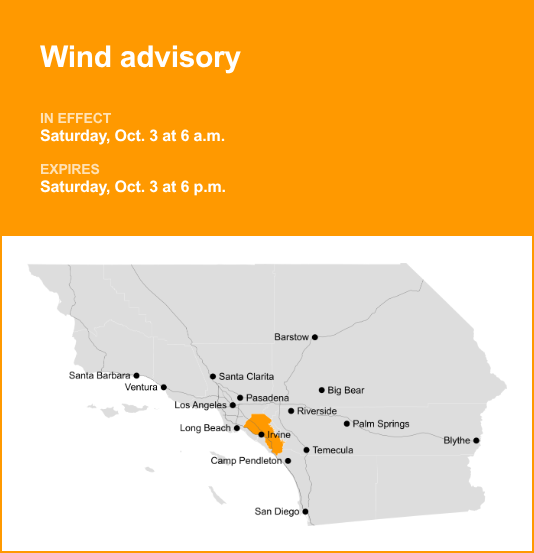
Wind advisory in place for Orange County for Saturday
- October 2, 2026
On Friday at 12:32 a.m. a wind advisory was issued by the National Weather Service valid for Saturday, Oct. 3 between 6 a.m. and 6 p.m. for Orange County.
The NWS San Diego CA informs, “East winds 15 to 25 mph with gusts to 40 mph expected.”
“Gusty winds will blow around unsecured objects. Tree limbs could be blown down and a few power outages may result. Heat related illnesses increase significantly during extreme heat events,” the NWS said. “Drink plenty of fluids, stay in an air-conditioned room, stay out of the sun, and check up on relatives and neighbors. Do not leave young children and pets in unattended vehicles. Car interiors will reach lethal temperatures in a matter of minutes. Winds this strong can make driving difficult, especially for high profile vehicles. Use extra caution.”
High wind alerts: Your guide to safety
When it comes to high wind alerts, staying informed is essential. Here’s a breakdown of the three-tiered alert system from the NWS and what each level entails:
High wind warning: Take action.
Sustained, strong winds with even stronger gusts are happening. Seek shelter. If you are driving, keep both hands on the wheel and slow down.
Wind advisory: Take action.
Strong winds are occurring but are not so strong as to warrant a High wind warning. Objects that are outdoors should be secured and caution should be taken if driving.
High wind watch: Be prepared.
Sustained, strong winds are possible. Secure loose outdoor items and adjust plans as necessary so you’re not caught outside.
How to prepare before strong winds approach
- Trim tree branches away from your house and power lines.
- Secure loose gutters and shutters.
- Identify an interior room of your house, such as a basement or interior bathroom, that you can take shelter in during high wind warnings.
- If you live in a mobile home, identify a sturdy building you can go to if the NWS issues a high wind or severe thunderstorm warning.
- Charge batteries of all essential items such as cell phones and booster packs, weather radios and power tools such as a reciprocating saw, which you might need to clear debris.
- Update your emergency kit and be sure to include enough food and water to last for 3 days for each person in your home.
- Make a list of items outside your home you will need to tie down or put away so that they don’t blow away or fly through a window. When the NWS issues a high wind watch, immediately secure these items to avoid damage or injury once the wind starts picking up.
How to act during strong winds
Take shelter:
- Immediately go inside a sturdy building during a high wind warning or severe thunderstorm warning and move to an interior room or basement.
- If you are in a mobile home, move to a sturdy building before the winds pick up or the storm system reaches your location.
If caught outside or driving:
- Take shelter in your car if you are not near a sturdy building. If possible, drive to a nearby sturdy building. Otherwise, move your car to a location where it is less likely to be hit by falling trees or power lines.
- If no shelter is available avoid trees, power lines, and the side of the road. Keep in mind that power lines that are laying on the ground may be live. Do not go near them! Try to find a place that will block blowing or falling debris.
- If you are driving and aren’t near a sturdy building, hold the steering wheel with both hands and slow down.
- Keep a distance from high profile vehicles such as trucks, buses and vehicles towing trailers. One strong gust of wind can be enough to flip one of these trailers onto its side.
What to do after strong winds subside
- Do not go near downed power lines. Report downed power lines to the police.
- Be careful when handling debris that may have blown into your yard.
For more local weather alerts, visit our Weather Advisory page
Orange County Register
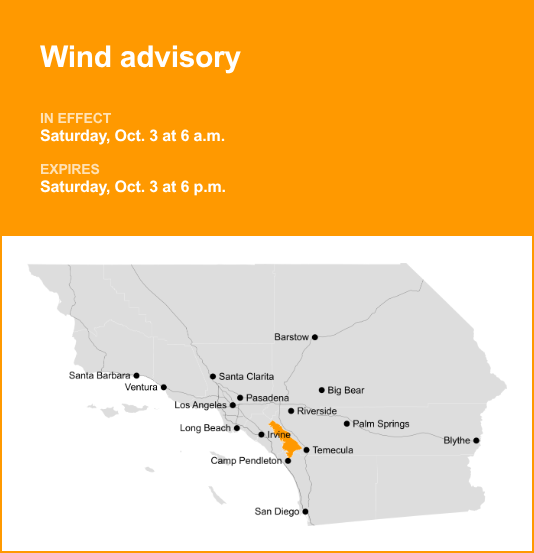
Wind advisory affecting Santa Ana Mountains Saturday
- October 2, 2026
On Friday at 12:32 a.m. a wind advisory was released by the National Weather Service valid for Saturday, Oct. 3 between 6 a.m. and 6 p.m. for Santa Ana Mountains/Foothills.
The NWS San Diego CA informs, “East winds 15 to 25 mph with gusts to 40 mph expected.”
“Gusty winds will blow around unsecured objects. Tree limbs could be blown down and a few power outages may result. Heat related illnesses increase significantly during extreme heat events,” according to the NWS. “Drink plenty of fluids, stay in an air-conditioned room, stay out of the sun, and check up on relatives and neighbors. Do not leave young children and pets in unattended vehicles. Car interiors will reach lethal temperatures in a matter of minutes. Winds this strong can make driving difficult, especially for high profile vehicles. Use extra caution.”
Understanding high wind alerts
When it comes to high wind alerts, staying informed is essential. The NWS categorizes high wind alerts into three levels, each signifying a different degree of risk:
High wind warning: Take action.
Sustained, strong winds with even stronger gusts are happening. Seek shelter. If you are driving, keep both hands on the wheel and slow down.
Wind advisory: Take action.
Strong winds are occurring but are not so strong as to warrant a High wind warning. Objects that are outdoors should be secured and caution should be taken if driving.
High wind watch: Be prepared.
Sustained, strong winds are possible. Secure loose outdoor items and adjust plans as necessary so you’re not caught outside.
How to prepare before strong winds approach
- Trim tree branches away from your house and power lines.
- Secure loose gutters and shutters.
- Identify an interior room of your house, such as a basement or interior bathroom, that you can take shelter in during high wind warnings.
- If you live in a mobile home, identify a sturdy building you can go to if the NWS issues a high wind or severe thunderstorm warning.
- Charge batteries of all essential items such as cell phones and booster packs, weather radios and power tools such as a reciprocating saw, which you might need to clear debris.
- Update your emergency kit and be sure to include enough food and water to last for 3 days for each person in your home.
- Make a list of items outside your home you will need to tie down or put away so that they don’t blow away or fly through a window. When the NWS issues a high wind watch, immediately secure these items to avoid damage or injury once the wind starts picking up.
How to act during strong winds
Take shelter:
- Immediately go inside a sturdy building during a high wind warning or severe thunderstorm warning and move to an interior room or basement.
- If you are in a mobile home, move to a sturdy building before the winds pick up or the storm system reaches your location.
If caught outside or driving:
- Take shelter in your car if you are not near a sturdy building. If possible, drive to a nearby sturdy building. Otherwise, move your car to a location where it is less likely to be hit by falling trees or power lines.
- If no shelter is available avoid trees, power lines, and the side of the road. Keep in mind that power lines that are laying on the ground may be live. Do not go near them! Try to find a place that will block blowing or falling debris.
- If you are driving and aren’t near a sturdy building, hold the steering wheel with both hands and slow down.
- Keep a distance from high profile vehicles such as trucks, buses and vehicles towing trailers. One strong gust of wind can be enough to flip one of these trailers onto its side.
What to do after strong winds subside
- Do not go near downed power lines. Report downed power lines to the police.
- Be careful when handling debris that may have blown into your yard.
For more local weather alerts, visit our Weather Advisory page
Orange County Register
Canyon football edges St. Margaret’s thanks to Kayden Phillips’ big second half
- October 2, 2026
ORANGE – Canyon quarterback Kayden Phillps had minus-2 yards rushing in the first half.
His second carry in the second half was a 19-yard gain. Then came a 6-yard gain and a few plays later he had a gain of 28 yards.
When the game ended Phillips had rushed for 151 yards and scored all three Canyon touchdowns in the Cobras’ 20-10 win over St. Margaret’s in a Kappa League opener Thursday at El Modena High.
Canyon is 5-1 overall. St. Margaret’s is 4-2.
Sacks in high school football are recorded in the rushing category, and Phillips was caught behind the line of scrimmage a few times in the first half. He threw only five passes in the second half while running with the ball 14 times in that second half.
“Our coaches told us just to do what we’re good at,” said Phillips, who was at Servite last season. “And I kept getting the ball.”
Phillips scored on a 6-yard run in the second quarter and scored on runs of 13 yards in the third quarter and 25 yards in the fourth quarter. He also completed 11 of 18 passes for 139 yards.
Canyon first-year coach Vinnie Lopez had dual-threat quarterbacks like Darius Cowens and Ben Jefferson when he was the head coach at Pacifica.
“And here, it’s Kayden,” Lopez said. “When the game’s on the line Kayden wants the ball. And if he’s doing this kind of stuff, why not?”
Canyon also had a couple of big defensive plays.
With Canyon ahead, 13-10, and St. Margaret’s driving, Canyon’s Skee Hitchens recovered a Tartans fumble in the end zone for a touchback. Hitchens also had an interception with 1:51 left in the game. Bo Booher made an interception in the second quarter that led to the Cobras’ first touchdown.
St. Margaret’s took a 3-0 lead on Gareth Thomas’ 34-yard field goal in the first quarter. Phillips’ 6-yard touchdown run followed the Booher interception. The kick for the extra point was no good, leaving Canyon with a 6-3 lead, which would be the halftime score.
Tartans receiver Jack Kleinhanzl made a great catch in the end zone, pulling the ball in between two defenders, for a 30-yard touchdown pass from Kai Letcher to put St. Margaret’s on top, 10-6 in the third quarter. Phillips scored on his 13-yard run to give the lead back to Canyon, 13-10, early in the fourth quarter and added his 25-yard scoring run with 2:16 left in the game.
St. Margaret’s plays at home against Portola in another Kappa League game on Oct. 9. Canyon plays a Kappa League game next Thursday against Fullerton at Fullerton High.
Canyon was penalized 14 times for 135 yards.
“The penalties were a crusher,” Lopez said. “We’ll have to clean that up before we play Fullerton.”
Orange County Register
Read MoreNews
- ASK IRA: Have Heat, Pat Riley been caught adrift amid NBA free agency?
- Dodgers rally against Cubs again to make a winner of Clayton Kershaw
- Clippers impress in Summer League-opening victory
- Anthony Rizzo back in lineup after four-game absence
- New acquisition Claire Emslie scores winning goal for Angel City over San Diego Wave FC
- Hermosa Beach Open: Chase Budinger settling into rhythm with Olympics in mind
- Yankees lose 10th-inning head-slapper to Red Sox, 6-5
- Dodgers remain committed to Dustin May returning as starter
- Mets win with circus walk-off in 10th inning on Keith Hernandez Day
- Mission Viejo football storms to title in the Battle at the Beach passing tournament