

Alexander: Former baseball scouts’ age discrimination suit was inevitable
- June 27, 2023
When 17 former baseball scouts filed a class action lawsuit against Major League Baseball in U.S. District Court in Denver last week, claiming age discrimination and charging that older scouts were not only pushed out but were subsequently blacklisted … well, it shouldn’t have been a surprise.
Rick Ingalls said nearly two years ago that this was coming.
Ingalls, 71, a Long Beach resident who scouted for the Angels, Chicago White Sox, Toronto Blue Jays, Seattle Mariners and Cincinnati Reds before he was let go by the Reds in 2018, talked to me then about how, among other things, analytics and technology had become a far higher priority in baseball front offices than the eye test and instincts and assessment of character that were at the heart of traditional scouting.
The sport has retrenched from a player development standpoint, with the reduction of the draft from 60-some rounds to 20 and the pruning of the minor leagues. And as the old ways were left behind, many veteran scouts – like Ingalls – were shoved aside as well.
“All the years I’ve been in this business, and I’ve been in it a long time, and I saw guys (get let go) and they just went away,” Ingalls said in a phone conversation Monday. “There was never, ‘Hey, wait a second. What happened here? Why? Why?’ So I always remembered that, and I thought when it finally happened to me, I said, you know what? I’m not the guy. I’m not going away.
“… We have a lot of guys (who were let go) that absolutely are in dire straits because they’re 50, middle-50s, you know. Where are you going to get another job when you work 25 or 30 years in one industry? Guys are driving Uber to pay for insurance. Guys have lost their houses. … They (the clubs) devastated a lot of lives here for whatever their reasoning is.”
And so here we are. The 17 individuals (including Ingalls) named as plaintiffs in the initial filing averaged 29 years in scouting, and even that average is deceptive. Paul Runge, a former Atlanta Braves player and not the former umpire, was just a scout for three years but had spent decades as a minor league coach, field coordinator and manager. Most of the men on that list had scouting tenures of between 25 and 39 years. The youngest is 55.
So what happens when you give your life to something and then find out it has no more use for you?
“These are employees that have sacrificed their lives for this, who have been in this game their whole life,” said Rick Ragazzo, 63, a scout for the San Francisco Giants, Dodgers and Braves during his 35-year career, in a video disseminated by Kilgore & Kilgore LLC, the Dallas law firm handling the scouts’ case.
“We played, we coached, we scouted. Some of us were in the front office making decisions. That track record should mean something, but I guess it doesn’t. I don’t know if we were allowed to, or if I was allowed to, adapt and become part of the new system, or if it was just something they thought I wasn’t able to do.”
Ted Lekas, 67 and a scout for multiple clubs for 34 years, told the Boston Globe that when he was released by Atlanta last October he was told the rationalization was that “the Braves’ payroll in 2023 was going to be so big, that they needed all the money they could get to finance the salary for the big leaguers.” And he said on a Kilgore & Kilgore video he’d earlier been told on “three different occasions” that he’d be back in 2023.
For what it’s worth, the Braves – part of a publicly traded company – reported income of $588 million in 2022, between the ballclub and the Battery development surrounding Truist Park. Their current 40-man payroll for luxury tax purposes, $242,219,167, is around $28 million higher than it was last year.
All that, and they can’t find a way to keep a scout that might make $100,000 a year?
Lekas also talked in his video about how there’d never been any established criteria for evaluating scouts, and “if you ever ask why you’re let go, the answer is, ‘We’re going in a different direction.’” That has happened a lot; he estimated that since 2015, at least 75 to 100 older scouts have been let go, and maybe 5% found work elsewhere in baseball.
And while there are 17 names in this suit right now, the suit estimates that more than 100 older scouts are part of the affected class. Ingalls said Monday the initial estimate of scouts who might join the suit was anywhere from 50 to 100, and “within a two- or three-day period, we got 20 more guys already.”
The suit alleges that MLB and its clubs, acting in concert, “engaged not only in systematically bringing about the separation from Clubs of Older Scouts to build a workforce of Younger Scouts, but in denying re-employment of Older Scouts by Clubs … based on a false stereotype that Older Scouts lacked the ability to use analytics and engage in video scouting with the same acumen as Younger Scouts.” It claims that the pattern “constitutes unlawful age discrimination” under the federal Age Discrimination in Employment Act as well as state anti-discrimination statutes.
MLB’s response to the lawsuit last week was a terse statement: “We do not comment on pending litigation. However, we look forward to refuting these claims in court.”
The prediction here? There will be a settlement, and you can likely use as a measuring stick the $185 million that MLB will pay minor league players to settle a suit alleging violations of federal minimum wage laws, though that disbursement to some 24,000 players has been held up because of an appeal over the percentage to be paid in legal fees.
“Part of me wants a lot of this stuff exposed, but the other part of me wants to get (unemployed scouts) the money as quickly as possible because they need it,” Ingalls said. “They lost salaries. They lost time on their pensions. You know, there’s a lot that went down the tubes. It was gone.
“These are baseball guys that had their baseball identities taken away. And you’re just supposed to go away and say, oh, okay, you know, career’s over? Because of what? Why is your career over when you can still work?”
Why, indeed?
jalexander@scng.com
Related Articles
Jo Adell returns to Angels for another cameo
Game Day: Angels’ strange weekend is ultimately a plus
Dodgers’ Will Smith takes his best All-Star shot, again
Dodgers lose to Astros in extra innings as Freddie Freeman reaches another milestone
Dodgers put Chris Taylor on IL with knee injury after all
Orange County Register
Read More
Leaders urge President Biden to expand the San Gabriel Mountains National Monument
- June 27, 2023
With the picturesque San Gabriel Mountains in the backdrop, local and national leaders converged on Eaton Canyon Nature Center in Pasadena on Monday, June 26, to urge President Joe Biden to expand the San Gabriel Mountains National Monument an additional 109,000 acres to the west.
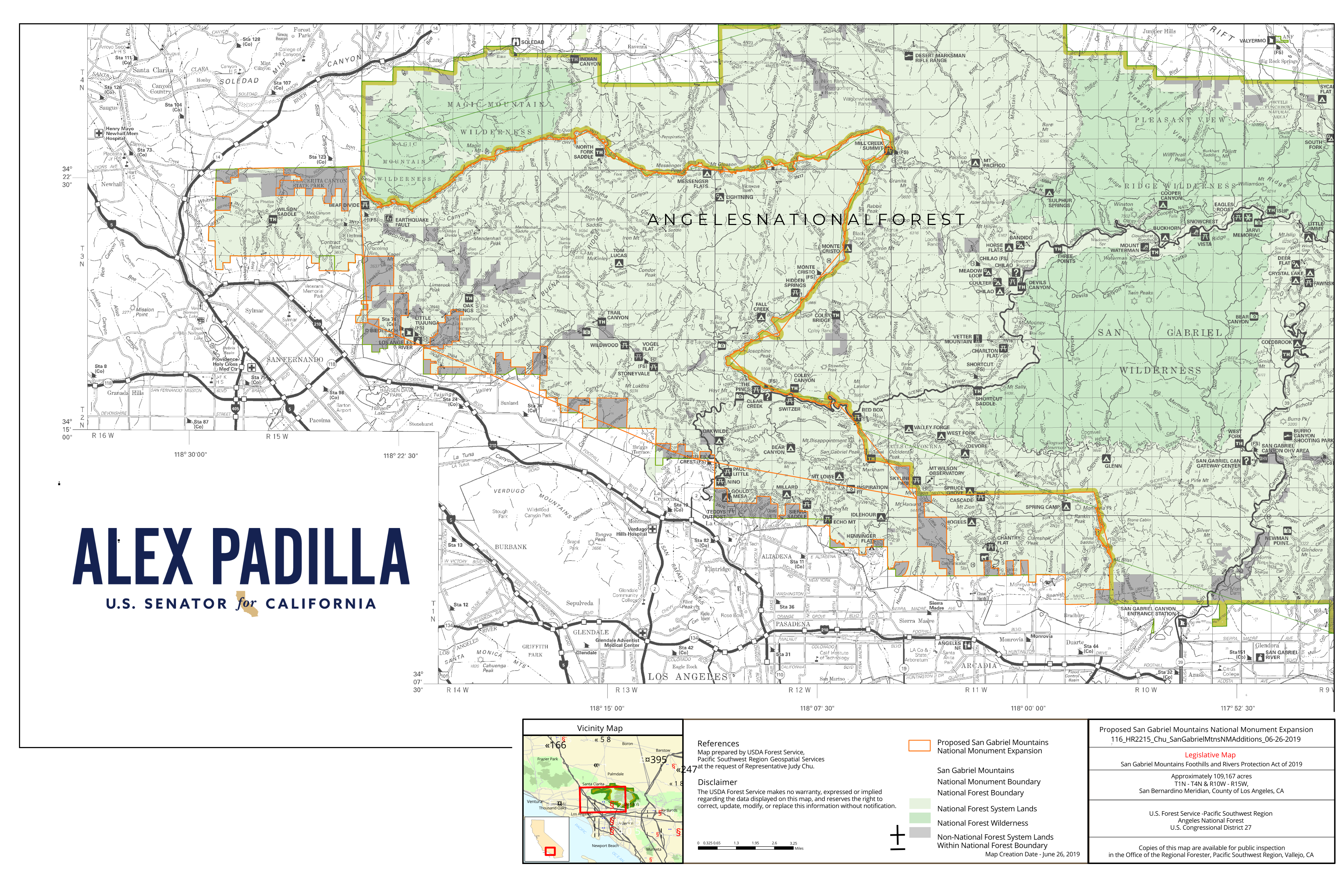
“The San Gabriel Mountains are among the most pristine and beautiful public lands in the country, and they are right here next to one of the nation’s densest and most park-deprived population centers,” said Rep. Judy Chu, D-Pasadena, who was joined by several elected leaders at all levels. “I’m so grateful to the diverse, vibrant group of leaders of this more than 20-year movement to protect the San Gabriel Mountains, and I hope that President Biden will recognize the importance of these lands by designating the western Angeles National Forest as part of the National Monument. “
The call for an expanded monument included U.S. Sen. Alex Padilla; Rep. Tony Cardenas, D-Panorama City; L.A. County Supervisor Kathryn Barger; Pasadena Mayor Victor Gordo; and Tongva Gabrieleno Chief Anthony Morales.
They called on the Biden administration to make use of the Antiquities Act, a 1906 law that allows the president to designate federal public lands, waters, and cultural and historical sites as national monuments via Presidential Proclamation.
The move would add-in regions of the western Angeles National Forest – from the Placerita Canyon Nature Center in the northwest, southwest to the Monrovia area — that were not included in the original 346,177 acres of federal land designated as a national monument by then-President Barack Obama in 2014.
The proposed expansion area is considered the “gateway” to the Angeles National Forest, making it one of the most visited parts of the forest.
“For Angelenos, the San Gabriel Mountains have been a lifelong connection to nature,” Padilla said. “For many low-income families in the Los Angeles area, this is the only access they have to green space and the educational and health benefits that come with it. And it is critical that we protect these public lands to promote environmental justice in our communities.”
Padilla said an order by the president would fulfill the “complete vision of permanently protecting the San Gabriel Mountains and all of their natural wonders.”
In May, both Padilla and Chu introduced legislation that would expand the San Gabriel Mountain National Monument, with Padilla’s PUBLIC Lands Act protecting more than 1 million acres of public land in California, and incorporating provisions of Chu’s San Gabriel Mountains Protection Act, which expands the monument by 109,00 acres, designates 31,000 acres as new or expanded wilderness areas, and adds 45.5 miles to the National Wild and Scenic Rivers System.
On June 8, they sent sent a letter to the White House urging the administration to take executive action and outlining the roadblocks similar bills faced in previous attempts to expand the monument, clearing the House five times in the last three years without ultimately being passed.
“As hopeful we are, we also have to be realistic,” Padilla said. “There’s a Republican majority in the House of Representatives that’s not giving us too much hope that we can get it done legislatively this year.”
Democratic presidents have long argued designating large swaths of land is needed to protect certain areas. Obama himself, propelled by an effort led by Chu and also a Republican-led House of Representatives, used the Antiquities Act in 2014 to do what two members of Congress and thousands of supporters could not do during the 11 years prior to his signature.
And even then, the designation did not come without controversy.
At the time, more than 150 protesters held signs in front of the park where Obama signed his executive order, saying they did not want the federal government to impose its will on the land or on its people. The bone of contention stems from the president’s use of the Antiquities Act, first used by President Teddy Roosevelt.
Last year, the state of Utah and two Republican-leaning rural counties sued the Biden administration over the president’s decision last year to restore two sprawling national monuments on rugged lands sacred to Native Americans that former President Donald Trump had downsized. Trump’s decision opened parts of the monuments up for mining, drilling and other development.
In the Utah lawsuit, plaintiffs argued the Biden administration interpreted the Antiquities Act in an overly broad manner and disregarded its original intent: protecting particular historical or archaeological sites. It cites provisions of the act that say designations should encompass “the smallest area compatible” with preservation goals.
Supporters of an expanded San Gabriel Mountains National Monument say the expansion will help address the climate and biodiversity crises by protecting important habitat and wildlife corridors for black bears, mountain lions, coyotes, bighorn sheep, and mule deer, as well as contribute to state and federal goals to conserve 30% of public lands and waters by 2030.
“Los Angeles County is one of the most densely populated areas in the nation and millions of our region’s residents have limited access to the outdoors,” said Belén Bernal, executive director for nonprofit environmental coalition Nature for All. “We know that lack of access to nature has negative health implications and is linked to higher rates of obesity and diabetes. That’s why it is so important that we ensure the permanent protection of the San Gabriel Mountains. This is one of the few places Angelenos can go to enjoy the outdoors close to home.”
Related links
Bill to expand San Gabriel Mountains National Monument could draw in Biden
At long last, adding front range back into San Gabriel Mountains National Monument
Adding acres back to monument in the San Gabriel Mountains
Pasadena Casting Club’s fight to protect San Gabriel Mountains National Monument: Larry Wilson
San Gabriel Mountains National Monument helps bring nature to children, chilren to nature: Guest commentary
The Associated Press contributed to this article.
Orange County Register
Read More
Chargers sign edge rusher Tuli Tuipulotu, their 2nd-round pick
- June 27, 2023
The Chargers on Monday signed Tuli Tuipulotu, an All-America edge rusher from USC who was their second-round pick in the 2023 draft. Tuipulotu started three seasons with the Trojans and earned first-team All-Pac-12 honors twice. He grew up in Hawthorne and starred at Lawndale High.
Tuipulotu, 20, led the Pac-12 and was third in the nation with 12½ sacks during the 2022 season. He was named to the All-America team and was the Pac-12 Defensive Player of the Year. He was credited with 114 tackles (65 solo) during his collegiate career at USC.
It’s anticipated that he’ll add significant depth to the Chargers’ edge rusher position behind Joey Bosa and Khalil Mack and under new defensive coordinator Derrick Ansley, who was promoted from secondary coach after the departure of Renaldo Hill to the Miami Dolphins during the offseason.
“He has a lot of the characteristics that we think translate to playing championship defense,” Chargers coach Brandon Staley said after Tuipulotu was selected 54th overall on April 28. “He’s really tough and rugged at the point of attack. He can rush from the outside and from the inside. He has versatility that way. He has the play style that we’re really attracted to.”
Tuipulotu was the only remaining unsigned player from the Chargers’ seven-player draft class.
Related Articles
Chargers’ Austin Ekeler says he’s not mad about lack of contract extension
Chargers’ J.C. Jackson nearing return from season-ending knee surgery
Center Corey Linsley on the Chargers’ O-line: ‘We’ve got to be a lot better’
Chargers’ talks with Justin Herbert on contract extension still ‘ongoing’
Chargers’ Rashawn Slater ‘100 percent’ again after season-ending injury
Orange County Register
Read More
College World Series: LSU hammers Florida to win its 7th national title
- June 27, 2023
By ERIC OLSON AP Sports Writer
OMAHA, Neb. — A day after giving up the most runs ever in a College World Series game, LSU cranked up its offense and won its first national title since 2009 with an 18-4 victory over Florida on Monday night in the third and deciding game of the championship series.
LSU (54-17) staved off elimination three times in bracket play and bounced back from the humiliating 24-4 loss in Game 2 to claim its seventh championship, second to USC’s 12.
“Right people, right place, right time,” Tigers coach Jay Johnson said. “This is the way it was supposed to go.”
The Tigers wiped out an early 2-0 deficit with a six-run second inning against Jac Caglianone (7-4). The runs kept coming until they finished with the most in a title game since USC’s 21-14 victory over Arizona State in 1998. The 14-run margin was the largest ever in a final. Their 24 hits were the most in a CWS game.
“It wasn’t our day, all the way around,” Gators catcher B.T. Riopelle said.
Thatcher Hurd (8-3) allowed Wyatt Langford’s two-run homer in the first and then allowed no hits or runs while retiring 18 of the next 21 batters. Riley Cooper took over to start the seventh and gave up Ty Evans’ CWS-record fifth homer, and Gavin Guidry finished the combined five-hitter.
There was speculation after Sunday’s blowout loss about the Tigers bringing back ace Paul Skenes for a third start in Omaha. He threw a combined 243 pitches over 15⅔ innings in two spectacular appearances, and he would have been working on three days of rest.
It turned out Skenes was able to watch from the dugout in the comfort of his sneakers while LSU poured on the runs and Hatcher kept dealing. Skenes headed to the bullpen to do some stretching in the seventh inning, but he went back to the dugout after the eighth and stayed there until he and his teammates rushed the mound when Guidry struck out Cade Kurland to end it.
Skenes was named the Most Outstanding Player of the CWS.
The overwhelmingly partisan LSU crowd included Kim Mulkey, coach of the national champion women’s basketball team and the mother of Kramer Robertson, who played shortstop on the 2017 team that lost to Florida in the CWS finals.
The Tigers had been pointing toward a title run since their first team meeting last August. Johnson brought back Southeastern Conference Player of the Year Dylan Crews and the rest of the core of his team’s 2022 lineup.
Three key transfers took LSU to a higher level. Skenes was the first college pitcher in 12 years with 200 strikeouts and could be the No. 1 pick in the amateur draft. Tommy White hit 24 homers and drove in a nation-leading 105 runs. Hurd was solid as a starter and reliever and matched his longest outing of the year in the title game.
The Tigers were the consensus No. 1 team in the polls from the preseason until the first week of May, when they were overtaken by Wake Forest. They finished the season well enough to be the No. 5 national seed in the NCAA Tournament, and they swept through regionals and super regionals in Baton Rouge to make it to Omaha for the first time since they were national runners-up six years ago.
LSU joined Mississippi, Mississippi State and Vanderbilt in a line of four straight national champions from the SEC.
“Oh my gosh, this is what I dreamed of since I was a freshman, holding this trophy,” Crews said. “We’re champions, baby, bringing it back to LSU. It’s been a long journey for us. We dealt with a lot of stuff. Just to finally say we’re national champions … I cannot wait to put another flag over the field. It’s going to be awesome.”
Florida (54-17) won the SEC regular-season title, was the No. 2 national seed and set school records for wins and home runs – the Gators hit 17 of the 35 homers by all teams in the CWS. But the Gators were unable to carry over the momentum from their record-setting production Sunday.
Caglianone, Florida’s two-way star, struggled with his command for a second straight start and was done on the mound after 1⅓ innings. He remained in the game as the designated hitter.
LSU got on the board when Jordan Thompson, who had been 1 for his last 30, singled in a run. It was tied after Caglianone hit Cade Beloso – his fifth hit batter in his 5⅔ CWS innings – and a walk to Crews put LSU in front. Cade Fisher relieved and gave up a couple of RBI singles and a sacrifice fly.
Josh Pearson’s fourth homer of the season highlighted the Tigers’ four-run fourth inning.
More to come on this story.
Related Articles
Florida sets College World Series record for runs in win over LSU that forces Game 3
Floyd fans 17 and Beloso’s HR in 11th gives LSU a win over Florida in CWS Game 1
SEC rules as Florida faces LSU in College World Series final
Stanford knocks Cal State Fullerton out of NCAA baseball tournament
Cal State Fullerton baseball stays alive in Stanford Regional
Orange County Register
Read More
Out-of-state abortion seekers in Orange, San Bernardino counties doubled since Dobbs decision
- June 27, 2023
In the year since the U.S. Supreme Court overturned a constitutional right to abortion, more than twice as many out-of-state patients have come to Orange and San Bernardino counties seeking abortions, according to Planned Parenthood.
“Often, when patients call us, we have an appointment in the next few days, but they will ask for an appointment two weeks out,” said Jon Dunn, president and CEO of Planned Parenthood of Orange and San Bernardino Counties, “because they recognize that it’s going to take them that long to organize childcare, find a way to get away from their job, and organize transportation.”
Dunn made the comments Monday morning, June 26, at an event outside Planned Parenthood’s health center in San Bernardino, alongside Rep. Pete Aguilar, D-San Bernardino.
In June 2022, with the Dobbs v. Jackson Women’s Health Organization decision, the U.S. Supreme Court overturned 1973’s Roe v. Wade decision, granting a federally recognized right to an abortion. The Dobbs decision threw the issue back to the states, opening the door for states to ban abortion outright. In the year since, 14 states have made abortion illegal while 11 have expanded access. And members of Congress on both sides of the issues have expressed a desire for national legislation on the matter.
“Republicans from California say one thing when they’re at home, and then they give their voting cards to the extremists in Washington when we’re working,” Aguilar said. “When given a chance, not a single Republican from California voted to protect women from traveling across state lines to get abortion care. Not a single California Republican voted to protect the right of women to get contraception.”
According to Planned Parenthood of Orange and San Bernardino Counties, in the year since the Dobbs decision, 451 out-of-state abortion patients have been seen in their clinics, as compared to 180 out-of-state abortion patients in the year prior.
Of the patients seen in the past year, 142 received services in San Bernardino County health centers, including 81 at the health center in the city of San Bernardino.
Out-of-state patients, who have to arrange for travel and often make child care arrangements, are getting abortions later than local patients are. According to Planned Parenthood, only 55% of out-of-state abortion patients were seen by Planned Parenthood in time for a medication abortion, which must be used within 10 weeks of conception. Local patients are able to get medication abortions 82% of the time.
According to Dunn, out-of-state patients come to Planned Parenthood in Orange and San Bernardino counties from 32 states, mostly Texas and Arizona, but also from states as far away as Florida. And patients from further west, including states where abortion remains legal, like in Nevada and Colorado, have also been coming to California.
“There’s such a surge coming from places like Texas and Arizona” at Nevada and Colorado clinics that “their own local patients can’t get in the door, so they look further and further west, until they can get an appointment,” Dunn said.
Out-of-state abortion patients requiring a surgical abortion are almost three times as likely to be in their second trimester as local patients are, according to Planned Parenthood.
Planned Parenthood has helped out-of-state abortion patients with an average of $488 in subsidies for travel and medical expenses.
Aguilar warned that the Dobbs decision wasn’t the end of restrictions on abortion.
“This is no longer the Republican Party (of) states’ rights. This is about a nationwide ban,” he said. “That means extremists like (Georgia representative) Marjorie Taylor Greene will write our laws and decide what’s best for our communities. That’s not the future we want. That’s not the future we want to share with our children.”
And Aguilar — the third-ranking Democrat in the House of Representatives — vowed that things would be different with Democrats in control of the House in the future.
“When Democrats take back the House, we look forward to passing abortion rights and making sure we enshrine those, the Women’s Health Protection Act, into law,” he added.
H.R. 3755, the Women’s Health Protection Act, introduced by Rep. Judy Chu, D-Pasadena, would make it legal for doctors to provide abortions across the United States. The bill passed in the previous session of Congress before stalling out in the Senate. A second version of the law is currently in limbo, and Chu has filed a petition to get the House to vote on the bill.
Aguilar wasn’t alone among Southern California Democrats marking the Dobbs anniversary — others commemorated the occasion with events in their districts. On Saturday, Chu participated in a similar event with Planned Parenthood Pasadena & San Gabriel Valley.
“In the year since (the Dobbs decision), we have seen what this new reality looks like, from patients in Texas driving through the night to arrive here in California to get the care they need to women being denied lifesaving medical treatment for miscarriages because they lived in states with abortion bans,” Chu said.
On Saturday, Rep. Norma Torres, D-Ontario, put out a statement condemning the Dobbs decision.
“A year ago, the Supreme Court decided women are second-class citizens who do not have the right to make decisions about their own bodies. By eliminating women’s right to self-determination, this conservative-majority court betrayed the ideals of our nation,” Torres is quoted as saying in a news release issued by her office. “I refuse to let today’s young girls grow up with fewer rights than I did, and I will not allow our country to backslide to the days of back-alley abortions. A woman’s decisions about her body are hers and hers alone.”
In June, a Gallup poll found that a record 69% of Americans believe abortion should be legal the first three months of pregnancy.
More on abortion in Southern California
Rep. Judy Chu’s abortion rights bill faces uphill struggle in the US Senate
Temecula won’t pursue abortion ban
Gov. Newsom says California will stockpile pills for abortion following Texas judge ruling
Rep. Judy Chu’s abortion rights bill faces uphill struggle in the US Senate
Ontario man faces 11 years for BB gun attacks on Pasadena Planned Parenthood
Can license plate data from California lead to criminal charges in Texas?
A year after the fall of Roe, San Gabriel Valley leaders reflect amid ongoing political battle
Orange County Register
Read More
Anaheim receives $5 million in federal funding for new bridges, trails around Honda Center
- June 26, 2023
Anaheim will get $5 million in in federal funding to support building new pedestrian bridges and trails near the Honda Center, officials announced Monday, June 26.
The funding will go to five projects planned to connect the OCVibe development that will be starting construction around the Honda Center, the Santa Ana River, Anaheim’s ARTIC train and bus station and a future river park next to Angel Stadium.
“In years to come, Anaheim’s riverfront will be the place to connect with nature and enjoy new entertainment and fun around Honda Center,” Mayor Ashleigh Aitken said in a news release.
Two of the five projects include a bridge that will carry pedestrians and bicyclists – but no cars – over the Santa Ana River and a new lane to separate bicycle traffic from pedestrians along the Santa Ana River Trail in Anaheim.
The pedestrian bridge will be north of Katella Avenue and will lead directly from the east side of the Santa Ana River into The Gardens park planned in front of the Honda Center.
There have been “multiple bicycle‐pedestrian collisions” on the Santa Ana River Trail, according to the grant application. In 2012, there was a fatal collision between a bicyclist and a pedestrian on the trail in Huntington Beach.
The money will also fund a nearly one mile extension of the Santa Ana River Trail from Katella Avenue to the Anaheim Coves. Currently, a dirt path links the two sections.
The Honda Center will also connect to Anaheim’s ARTIC station via a new pedestrian bridge over Katella Avenue, allowing people to bypass the wide road they would normally have to cross when there’s an event.
The fifth project the money will fund is an elevated pedestrian pathway that will lead people from that new Katella Avenue bridge to ARTIC. AMTRAK and Metrolink already stop at ARTIC, and the site is a planned station for California’s high-speed rail system.
The areas surrounding the projects in Anaheim are all in the top 10% in pollution levels for the state so the projects intend to get more cars off the road, according to the grant application.
Funding for the projects comes from a Department of Transportation grant program, which is a part of the Infrastructure Investment and Jobs Act Congress passed in 2021.
The city expects to complete planning on these projects by 2025.
Related Articles
Gwen Stefani drops new single ‘True Babe’ ahead of sold-out Honda Center show
Honda Center turns 30: Here are the biggest acts that played the Anaheim arena
No Doubt’s Gwen Stefani will headline Honda Center’s 30th anniversary show
Orange County Register
Read More
Next big advance in cancer treatment may be a vaccine
- June 26, 2023
By Carla K. Johnson | Associated Press
SEATTLE — The next big advance in cancer treatment could be a vaccine.
After decades of limited success, scientists say research has reached a turning point, with many predicting more vaccines will be out in five years.
These aren’t traditional vaccines that prevent disease, but shots to shrink tumors and stop cancer from coming back. Targets for these experimental treatments include breast and lung cancer, with gains reported this year for deadly skin cancer melanoma and pancreatic cancer.
“We’re getting something to work. Now we need to get it to work better,” said Dr. James Gulley, who helps lead a center at the National Cancer Institute that develops immune therapies, including cancer treatment vaccines.
More than ever, scientists understand how cancer hides from the body’s immune system. Cancer vaccines, like other immunotherapies, boost the immune system to find and kill cancer cells. And some new ones use mRNA, which was developed for cancer but first used for COVID-19 vaccines.
For a vaccine to work, it needs to teach the immune system’s T cells to recognize cancer as dangerous, said Dr. Nora Disis of UW Medicine’s Cancer Vaccine Institute in Seattle. Once trained, T cells can travel anywhere in the body to hunt down danger.
“If you saw an activated T cell, it almost has feet,” she said. “You can see it crawling through the blood vessel to get out into the tissues.”
Patient volunteers are crucial to the research.
Kathleen Jade, 50, learned she had breast cancer in late February, just weeks before she and her husband were to depart Seattle for an around-the-world adventure. Instead of sailing their 46-foot boat, Shadowfax, through the Great Lakes toward the St. Lawrence Seaway, she was sitting on a hospital bed awaiting her third dose of an experimental vaccine. She’s getting the vaccine to see if it will shrink her tumor before surgery.
“Even if that chance is a little bit, I felt like it’s worth it,” said Jade, who is also getting standard treatment.
Progress on treatment vaccines has been challenging. The first, Provenge, was approved in the U.S. in 2010 to treat prostate cancer that had spread. It requires processing a patient’s own immune cells in a lab and giving them back through IV. There are also treatment vaccines for early bladder cancer and advanced melanoma.
Early cancer vaccine research faltered as cancer outwitted and outlasted patients’ weak immune systems, said Olja Finn, a vaccine researcher at the University of Pittsburgh School of Medicine.”All of these trials that failed allowed us to learn so much,” Finn said.
As a result, she’s now focused on patients with earlier disease since the experimental vaccines didn’t help with more advanced patients. Her group is planning a vaccine study in women with a low-risk, noninvasive breast cancer called ductal carcinoma in situ.
More vaccines that prevent cancer may be ahead too. Decades-old hepatitis B vaccines prevent liver cancer and HPV vaccines, introduced in 2006, prevent cervical cancer.
In Philadelphia, Dr. Susan Domchek, director of the Basser Center at Penn Medicine, is recruiting 28 healthy people with BRCA mutations for a vaccine test. Those mutations increase the risk of breast and ovarian cancer. The idea is to kill very early abnormal cells, before they cause problems. She likens it to periodically weeding a garden or erasing a whiteboard.
Others are developing vaccines to prevent cancer in people with precancerous lung nodules and other inherited conditions that raise cancer risk.
“Vaccines are probably the next big thing” in the quest to reduce cancer deaths, said Dr. Steve Lipkin, a medical geneticist at New York’s Weill Cornell Medicine, who is leading one effort funded by the National Cancer Institute. “We’re dedicating our lives to that.”
People with the inherited condition Lynch syndrome have a 60% to 80% lifetime risk of developing cancer. Recruiting them for cancer vaccine trials has been remarkably easy, said Dr. Eduardo Vilar-Sanchez of MD Anderson Cancer Center in Houston, who is leading two government-funded studies on vaccines for Lynch-related cancers.
“Patients are jumping on this in a surprising and positive way,” he said.
Drugmakers Moderna and Merck are jointly developing a personalized mRNA vaccine for patients with melanoma, with a large study to begin this year. The vaccines are customized to each patient, based on the numerous mutations in their cancer tissue. A vaccine personalized in this way can train the immune system to hunt for the cancer’s mutation fingerprint and kill those cells.But such vaccines will be expensive.
“You basically have to make every vaccine from scratch. If this wasn’t personalized, the vaccine could probably be made for pennies, just like the COVID vaccine,” said Dr. Patrick Ott of Dana-Farber Cancer Institute in Boston.
The vaccines under development at UW Medicine are designed to work for many patients, not just a single patient. Tests are underway in early and advanced breast cancer, lung cancer and ovarian cancer. Some results may come as soon as next year.
Todd Pieper, 56, from suburban Seattle, is participating in testing for a vaccine intended to shrink lung cancer tumors. His cancer spread to his brain, but he’s hoping to live long enough to see his daughter graduate from nursing school next year.
“I have nothing to lose and everything to gain, either for me or for other people down the road,” Pieper said of his decision to volunteer.
One of the first to receive the ovarian cancer vaccine in a safety study 11 years ago was Jamie Crase of nearby Mercer Island. Diagnosed with advanced ovarian cancer when she was 34, Crase thought she would die young and had made a will that bequeathed a favorite necklace to her best friend. Now 50, she has no sign of cancer and she still wears the necklace.
She doesn’t know for sure if the vaccine helped, “But I’m still here.”
The Associated Press Health and Science Department receives support from the Howard Hughes Medical Institute’s Science and Educational Media Group. The AP is solely responsible for all content.
Orange County Register
Read More
Tourist from Orange recorded viral video of man etching into wall of the Colosseum in Rome
- June 26, 2023
Ryan Lutz was so appalled at the sight he stumbled upon while strolling around the famed Colosseum in Rome, the tourist from Orange started filming with his phone.
The footage shows a person appearing to etch names into the nearly 2,000-year-old bricks of the ancient amphitheater, defacing one of the most famous landmarks in the world – one that draws millions of visitors each year.
The video of the June 23 incident has made international news, drawing heavy criticism for the apparent act of vandalism. Italy’s culture minister, Gennaro Sangiuliano, has called for the person to be “identified and sanctioned.”
“I consider it very serious, unworthy and a sign of great incivility that a tourist defaces one of the most famous places in the world, a historical heritage (site) such as the Colosseum, to carve the name of his fiancée,” Sangiuliano tweeted on Monday, June 26. “I hope that whoever carried out this act will be identified and sanctioned according to our laws.”
Lutz, reached by phone in Athens, Greece, on Monday, June 26, said graffiti “bugs the hell out of me,” especially at such a historical site, so he was compelled to take out his phone and start filming.
As shown in the video, Lutz came up from behind the man who appears to be etching into the brick, with Lutz mumbling just loud enough to get his attention.
“Are you serious, man?” Lutz said, following with a few profanities to emphasize his outrage.
The man gave him a smile and continued etching, which Lutz said irked him even more.
“No shame, whatsoever,” Lutz said. “After that I think, ‘OK, I have to notify someone.’”
He found a guard at the Colosseum’s exit to report the man, saying he had video proof. But after Lutz pointed the man out, he said the security guard returned to his post, saying there was nothing he could do because he didn’t witness the act happening.
So Lutz asked to see a supervisor and said he was assured the authorities would be contacted and something would be done about it, but that Lutz could leave.
“It was kind of a bummer end for my trip to the Colosseum,” he said.
He got back to his hostel and told his bunkmate about the encounter, still riled up. It was suggested Lutz post his video, which he did, uploading it on Reddit.
Little did he know how far it would go or the outrage that would ensue. International media has picked up the story and the short video he took spread.
Related Articles
OCMA changes things up for summer
$9.3 billion OC budget proposal focuses on health care, wrongful convictions
Tuesday Night Dance at Segerstrom Center turns everyone into a dancer
Buena Park council to consider housing development to replace closed Sears
Muzak’s aural assault is one of life’s little annoyances
If convicted of a crime, the man could face a fine of at least $16,360 or up to five years in prison, CNN reported.
The Daily Mail in the UK interviewed Alfonsina Russo, director of the Colosseum, who said the police are attempting to track down the man.
‘When you get uneducated people at the Colosseum this kind of hooliganism happens and I hope there are no copycats,” Russo said to the Daily Mail.
According to the BBC, a Russian tourist in 2014 was fined about $20,000 and given a four-month prison sentence for carving his initial, K, onto a wall of the Colosseum. The Russian tourist was the fifth foreign visitor that year to be fined for defacing the Colosseum, according to the BBC, and authorities in Rome announced plans to increase surveillance cameras at the ancient monument.
In 2020, an Irish tourist was accused by Colosseum security of carving his initials into the monument.
The Colosseum, considered one of the seven wonders of the modern world, is a World Heritage Site, along with 54 other Italian sites that comprise the city’s historic center.
Ryan Lutz, of Orange, seen at the Colosseum in Rome, Italy, where he took a viral video of a man etching into the historic monument. (Photo courtesy of Lutz)
Lutz is on a two-month tour around Europe, a needed break after recently graduating with a geography degree from Cal Poly Pomona. Between visiting ancient sites and exploring, he’s now answering news media interview requests as he continues his journey.
The traveling tourist said he lived abroad when he was 19 in London and said it’s important to him to try to change people’s perception of American tourists.
“I don’t want that reputation. I try my best to be a humble, dedicated traveler,” Lutz said. “I appreciate other countries and I am there as their guest. Don’t mess around with your host country.”
CNN contributed to this report.
Orange County Register
Read MoreNews
- ASK IRA: Have Heat, Pat Riley been caught adrift amid NBA free agency?
- Dodgers rally against Cubs again to make a winner of Clayton Kershaw
- Clippers impress in Summer League-opening victory
- Anthony Rizzo back in lineup after four-game absence
- New acquisition Claire Emslie scores winning goal for Angel City over San Diego Wave FC
- Hermosa Beach Open: Chase Budinger settling into rhythm with Olympics in mind
- Yankees lose 10th-inning head-slapper to Red Sox, 6-5
- Dodgers remain committed to Dustin May returning as starter
- Mets win with circus walk-off in 10th inning on Keith Hernandez Day
- Mission Viejo football storms to title in the Battle at the Beach passing tournament